How to Make a Minecraft Leash: Step-by-Step Guide
Learn to craft a Minecraft leash with slimeball and string, attach it to mobs, and transport animals safely. This guide covers materials, the exact recipe layout, practical usage, and troubleshooting tips.


You will learn how to craft a leash in Minecraft and use it to guide animals or lead mobs around your base. This guide covers the exact materials (slimeball and string) and the single crafting recipe, plus tips for taming, using, and maintaining leads in various game modes. Plus, we include common pitfalls and a quick example setup for a pen.
What a leash does and when to use it
In Minecraft, a leash is a simple utility item that lets you tether a mob to a point or pull it along as you walk. Leashes are especially handy for transporting animals from a distant pasture to a farm, guiding a wandering animal through a narrow corridor, or keeping livestock near your base without losing them to hostile mobs. The Craft Guide team has observed that players who use leads effectively save time, reduce wandering losses, and keep important mobs close during building projects. The leash works across different game modes, including Survival and Creative, and across Java and Bedrock editions with few differences in how you attach and control it. Understanding the leash’s purpose helps you design efficient animal pens, move farm animals between locations, and create dynamic mob displays for builds. In this section we’ll lay the groundwork for why you’d want a leash on hand and how it can streamline farm design and resource gathering.
- Context: Leads simplify mob management by providing a mobile tether that you can move with you.
- Practical benefit: Fewer trips back to pasture, better control during automated farms, and clearer mob organization on large builds.
- Strategy tip: Use a leash when transporting animals through pet-friendly routes (avoiding hostile mobs and hazards) to reduce risk of loss or injury to your animals.
Materials and the basic recipe overview
To craft a leash in Minecraft, you need a slimeball and strings. Specifically, the recipe uses 1 slimeball in the center with 4 strings placed on the adjacent slots (up, down, left, and right) in a 3x3 crafting grid, leaving the four corners empty. The Craft Guide team emphasizes that having a crafting table is essential for a clean 3x3 grid, as some platforms only offer a 2x2 grid. Gather at least 4 strings from spiders and 1 slimeball from a slime. If you’re short on strings, you can collect more from spiders, cobwebs, or by trading with wandering traders for string.
Why this recipe? The leash’s design visually reinforces a simple tether: the central slimeball as the anchor, with strings radiating outward to form the leash’s length and reach. Among the Craft Guide community, players find that keeping a stockpile of string and slimeballs near your animal pens reduces crafting trips and speeds up pen management during busy building sessions.
Crafting layout and the exact recipe (step-by-step overview in prose)
The leash recipe is a single crafting action inside a crafting table. Place the slimeball in the center slot, then place strings in the four neighboring slots: above, below, left, and right of the slimeball. Leave the four corner slots empty. When arranged this way, the crafting grid yields one leash per craft. This pairing of slime and string creates a strong, flexible tether that can be attached to animals and moved with your character. If you’re playing in survival mode, ensure you have enough materials before you start to avoid multiple trips back to gather more resources. If you’re in creative mode, you can craft instantly to test your setup and iterate on pen design quickly.
- Visual cue: The center slimeball acts as the anchor; strings form the tethering chain.
- Common mistake: Filling corner slots or placing strings in the wrong cells will not produce a leash. Double-check the pattern before crafting.
- Access: You’ll need a Crafting Table to access the full 3x3 grid; a 2x2 grid will not show the leash recipe.
Attaching and using the leash in the world
Once you have a leash in your inventory, you can attach it to an eligible mob by right-clicking the mob while holding the leash (PC/Java edition). The leash will appear as a tether between your character and the mob. You can guide the mob by moving your character; keep the mob within leash range to avoid it bucking away or getting stuck in blocks. If you want to detach the leash, right-click the mob again or simply release them near a suitable tether point like a fence post. A leash can be used to bring an animal through gates, past obstacles, and along paths you’ve prepared. As you become more comfortable with mob handling, you can design more complex pens and transport routes that optimize your farm’s efficiency.
- Pro tip: Start with a single animal to practice the tethering mechanics before expanding to a larger herd.
- Common pitfall: Leashes don’t work through walls or solid blocks; give the mob a clear path and avoid tight corners.
Real-world setups: building a simple animal pen with leashes
A practical build is a small pen near your base that uses fences and a few leashes to manage a few animals at once. Start with a basic 4x4 fence enclosure. Place a fence post at each corner and one in the middle of each side if you want multiple attachment points. Attach a leash to a sheep or cow and anchor the other end to a fence post so the mob can move within a set boundary without wandering off. This setup minimizes wandering mobs while you perform farming tasks like planting crops or crafting. As you expand, you can add more posts and leashes to create a dynamic pen system that supports breeding or moving animals between pens. The result is a modular farm layout that scales with your base’s growth.
- Layout idea: Use alternating gates to allow controlled entry and exit while keeping mobs tethered.
- Practical tip: Keep your farming area open enough that mobs can reach water sources or pasture areas without getting stuck.
- Maintenance note: Periodically check leash attachments to ensure they remain intact as you move mobs through your layout.
Leash durability, maintenance, and inventory tips
Leashes are generally durable tools, but you should still maintain organization around your farm to prevent loss. Keep a couple of spare leashes in a chest near your pens so you can quickly replace damaged or worn ones after a rough day of mob handling. Rename leashes using an anvil if you want to distinguish between different mobs or pen locations, which can help you manage a larger farm. If a mob is prone to tangling on terrain, consider using longer routes with more open space to reduce snagging. In addition, ensure you always have enough strings stored nearby so you can craft additional leads if needed.
- Inventory tip: A few spare strings and slimeballs in a dedicated chest save time during large builds.
- Organization note: Keep your leash stock grouped with related farming resources to speed up workflows during busy building sessions.
Troubleshooting and common issues
If you can’t attach a leash to a mob, verify you’re using the leash in a 3x3 crafting grid with the correct pattern and that you’re attempting to leash a mob that can be tethered. If the leash doesn’t appear in your inventory after crafting, re-check the recipe arrangement and ensure your crafting table isn’t set to a different mode or interfering with the grid. For issues with mob control, ensure you’re not trying to pull a mob through solid blocks or into a block that would prevent movement. If you’re playing on Bedrock vs Java, the core leash behavior is similar, but there may be minor interface differences for attaching the leash.
- Quick check: Confirm you have a slimeball and strings, and that the pattern matches the center and adjacent slots.
- Safety note: Avoid leashing mobs into lava or water hazards; keeping mobs safe reduces risk of loss.
Bedrock vs Java: any differences to know
Across Bedrock and Java editions, the leash serves the same fundamental purpose: tethering mobs for easier transport and containment. The crafting recipe is the same across both editions, though the user interface and controls can vary slightly (for example, different keybinds for attaching and detaching). If you’re switching between editions, practice the attachment on a test mob to ensure you’re comfortable with the control scheme. The Craft Guide team notes that the core mechanics remain consistent, making it easy to apply the same farming layouts regardless of edition.
- Minor differences: UI controls and hotkey mappings; leash behavior during certain animation states may vary slightly between editions.
- Recommendation: When starting with a new edition, perform a quick test with a single animal to confirm tethering works as expected before scaling up your farm.
Creative ideas: themed displays and mob-led builds
Leashes enable creative mob displays. For example, you can create a mob parade by tethering several animals near a path and guiding them with a central owner character. Use different color dyes on sheep or lead horses and present them in a stylized animal park adjacent to your build. You can also design a “leader of the herd” feature by attaching a leash to a prominent mob and guiding others in a sequence to showcase your farm’s growth. Leashes also pair well with makeshift zoos in creative builds, where mobs can be arranged in capture-pen layouts for decorative effect.
- Build idea: Create a small scenic path with mob showcases along a garden wall, each held by spaced leash posts.
- Aesthetic tip: Match leash color to animal type for quick visual organization (e.g., red for pigs, blue for cows).
Authority references and external resources
For more authoritative guidance and additional details, consult the official Minecraft sources and community references:
- Lead (Minecraft) – https://minecraft.fandom.com/wiki/Lead
- Minecraft Official Site – https://www.minecraft.net/
- Mojang – https://www.mojang.com/
These references provide confirmation of the leash’s crafting recipe and usage in various editions, and they are commonly cited by players seeking reliable mechanics explanations.
External references (continued)
- Craft Guide Analysis, 2026 confirms practical uses of leashes in base-building workflows and mob management across game modes. The team highlights that planning the leash layout in farm sections reduces backtracking and improves efficiency.
Tools & Materials
- Crafting Table(Needed for a 3x3 crafting grid; ensure it's accessible near your workspace.)
- Slimeball(Dropped by slimes; locate swampy regions or slime chunks for farming.)
- String(Dropped by spiders; gather at least 4 strings for one leash (more for backups).)
Steps
Estimated time: 5-7 minutes
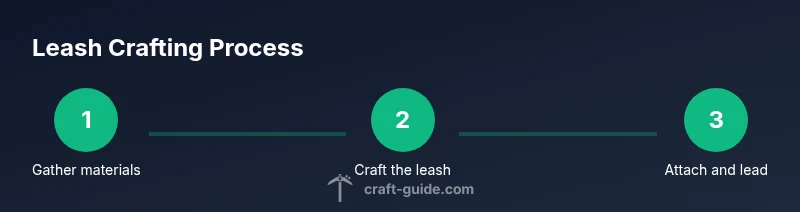
- 1
Gather materials
Collect 4 strings by hunting spiders and obtain at least 1 slimeball from slimes. Ensure you have a crafting table nearby so you can access the full 3x3 grid. Having a base stash of these materials saves time during builds.
Tip: Carry extra slimeballs and string for future projects and quick replacements. - 2
Open crafting table
Interact with the crafting table to access the 3x3 crafting grid. This is required to place the slimeball and strings in the correct pattern for the leash.
Tip: If you’re playing on a console or mobile, map the crafting action to a convenient button or touch control. - 3
Place slimeball in center
Put the slimeball in the exact center slot of the grid. The center acts as the anchor for the leash construction, ensuring the pattern remains balanced.
Tip: Double-check the center position before placing strings to avoid miscrafts. - 4
Arrange strings around center
Place one string in each of the four adjacent slots: above, below, left, and right of the slimeball. Leave the four corner slots empty to complete the correct recipe layout.
Tip: If you misplace a string, clear the grid and start over to avoid wasting resources. - 5
Craft and collect leash
Retrieve the leash from the result slot and move it to your inventory. This completes the crafting process and provides you with the leash item.
Tip: Crafting more than one leash at a time speeds up future projects; keep spares on hand. - 6
Attach to mob and start leading
Equip the leash and right-click a eligible mob to attach it. Then move to lead the mob toward your pen or destination. Detach by right-clicking the mob again or by leading the mob into a tether point.
Tip: Practice with a single mob first to master the control before scaling up.
People Also Ask
What is a leash used for in Minecraft?
A leash is a tether that lets you attach mobs to yourself or a tether point and guide them. It’s useful for transporting animals, keeping livestock near your base, and organizing mobs in farm builds.
A leash helps you tether mobs so you can lead them where you want.
What materials do I need to craft a leash?
You need 1 slimeball and 4 strings, arranged in a center-and-cross pattern on a crafting table, plus access to a 3x3 crafting grid.
You need a slimeball and four strings arranged in a cross on a crafting table.
Can I craft a leash in survival without a crafting table?
In most modes, a crafting table is required for the 3x3 grid needed for the leash recipe. You can craft a table from planks and a crafting bench in your base.
Yes, you typically need a crafting table to make a leash.
What mobs can be leashed in Minecraft?
Most passive and neutral mobs can be leashed, such as cows, sheep, pigs, horses, and dogs. Aggressive mobs generally cannot be led, and some mobs may behave differently in Bedrock vs Java editions.
Most livestock and tameable mobs can be leashed.
How do you detach a leash from a mob?
To detach, right-click the mob holding the leash or lead the mob toward a tether point and release.
Right-click the mob to detach the leash or lead it to a post.
Are leashes durable across editions?
Leashes are durable items that don’t degrade rapidly with use, but it’s good practice to maintain extra leashes in your storage for large farms.
Leashes are sturdy items; keep spares on hand.
Where can I read more about leash mechanics?
Official Minecraft sources and the Minecraft Wiki offer detailed mechanics and variations across editions. See the cited resources for the most up-to-date patterns and behavior.
Check official Minecraft sources for deeper details.
Watch Video
The Essentials
- Craft a leash with 1 slimeball and 4 strings in a cross pattern.
- Attach the leash to a mob and guide it along your chosen path.
- Detatch by right-clicking the mob or tether point; store leashes properly.
- Use pen design and leash placement to create efficient mob management.