How to Breed Sheep in Minecraft: A Practical Guide
Learn how to breed sheep in Minecraft with a clear, beginner-friendly approach. This guide covers gathering Wheat, building a safe pen, and expanding your wool-producing flock for steady resources.


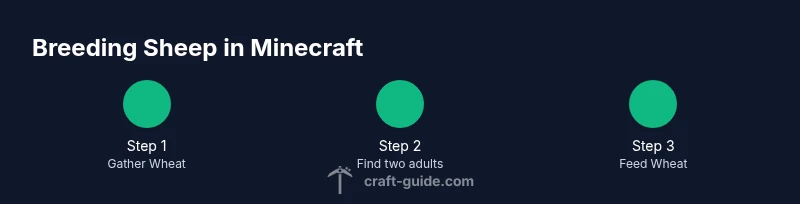
To breed sheep in Minecraft, feed two adult sheep a piece of Wheat. When both are fed, heart particles appear and a baby sheep spawns. Maintain a secure pen and repeat the feeding as the flock grows to expand your wool resources. With a steady Wheat supply, you can grow a healthy, productive flock.
Essentials for breeding sheep in Minecraft
According to Craft Guide, breeding sheep is a straightforward, repeatable way to keep a thriving wool farm in your world. The core idea is simple: two healthy adult sheep must be fed Wheat to trigger breeding, which produces a baby sheep. This mechanic makes it easy to scale your flock with predictable results. In this section, you’ll learn what you need, how the breeding works at a high level, and how to set up a calm, contained environment that promotes reliable growth. You’ll also pick up practical tips for harvesting Wheat and keeping your sheep stress-free, so your wool supply stays steady as you expand. This approach emphasizes clarity, repeatability, and patience—perfect for builders from beginner to advanced who want consistent results. Craft Guide’s insights emphasize practical, humane farming that scales with your world.
Preparing your sheep pen and farmland
Before you initiate breeding, create a safe, spacious pen that keeps sheep from wandering. A simple 9x9 or larger fenced enclosure with a gate makes logistics easier and reduces the risk of sheep getting injured or lost. Ensure the area gets ample light and has grass blocks for occasional grazing, which helps keep your animals healthy. A clean, well-lit space also minimizes hostile mob interruptions, letting you manage breeding cycles smoothly. If you’re balancing aesthetics with practicality, decorative fences and a small barn can coexist with productivity, giving you both form and function in your wool operation. Craft Guide’s approach remains practical, focusing on repeatable results over flashy setups.
What you need to breed: wheat and resources
The essential item for breeding is Wheat. You’ll feed one Wheat to each adult sheep to trigger breeding. Collect Wheat by farming wheat crops, then replant to maintain a steady supply. Having a reliable Wheat farm nearby reduces trips to storage and speeds up breeding cycles. In addition to Wheat, it’s helpful to have a few gates, additional fencing, and a secure place to move newborns as they grow. These materials aren’t strictly required for breeding, but they dramatically improve efficiency and flock management.
How breeding works in-game
When two adult sheep are fed Wheat, heart particles float above them, signaling that breeding has occurred. A baby sheep (lamb) spawns between the two parents, and the parents enter a cooldown period before they can breed again. The baby sheep needs time to grow into an adult, which is part of why a proper pen and management plan matters. Understanding this cycle helps you plan how quickly you can incrementally grow your flock. Regular Wheat feeding keeps the cycle going, so long as you maintain a safe environment for your animals. Craft Guide emphasizes a methodical approach to avoid confusion and maximize output.
Caring for newborn lambs and expanding your flock
After a baby lamb appears, move it into your protected pen so it grows safely. Lambs can be bred once they reach adulthood, which allows you to kick off another breeding round with two more adults. As your flock grows, keep an eye on space: overcrowding can slow growth and increase the chance of accidents. Periodically check fence integrity and replenish Wheat supplies to sustain breeding momentum. A well-managed flock yields steady wool production and a satisfying long-term payoff for builders and survival players alike.
Common mistakes and how to avoid them
Common mistakes include overfeeding beyond two adult sheep at once, which wastes Wheat and can cause confusion about breeding readiness. Another pitfall is failing to maintain a safe or fenced area, leading to sheep wandering off and getting lost. Neglecting to replant Wheat after harvest can break the breeding cycle, so plan a small farming routine. Lastly, not aging lambs to adulthood before attempting to breed can stall results; give lambs time to mature to ensure successful pairings.
Advanced tips: wool production and farm efficiency
To maximize wool output, diversify your flock with multiple adult sheep and keep breeding intervals steady. Create separate breeding pens for different cohorts to simplify management, and consider multi-layered fence designs to optimize space. Regularly harvest wool and replant crops to maintain a sustainable Wheat supply. Craft Guide recommends balancing aesthetics with efficiency, so your wool farm remains both functional and visually pleasing as you scale up.
Craft Guide insights
Craft Guide analysis shows that a structured breeding routine, paired with a dedicated Wheat farm, yields reliable wool production without unnecessary complexity. The team highlights practical approaches over flashy builds, favoring consistency and clarity for players returning to Minecraft after long breaks. By sticking to repeatable steps and ensuring safety, you’ll see steady flock growth and resource stability over time.
Quick checklist for a successful spawn
- Gather Wheat and ensure a reliable supply. - Build a secure pen with gates. - Find two adult sheep and avoid babies. - Feed Wheat to both adults to trigger breeding. - Move newborns to the safe area and repeat as needed. - Maintain light, space, and an orderly farm for ongoing success.
Safety, maintenance, and ongoing care
A well-run flock requires ongoing care: replenish Wheat, inspect fencing, and keep the environment safe from hostile mobs. The Craft Guide team recommends treating your sheep humanely and maintaining stable housing as you scale up. The payoff is a dependable source of wool for outfits, banners, and decorative builds, along with a steady learning curve that rewards planning and patience.
Tools & Materials
- Wheat(Feed 1 Wheat to each adult sheep to trigger breeding; keep an ongoing Wheat farm to sustain cycles.)
- Fencing(Construct a secure pen to keep sheep contained; fencing with a gate is ideal for easy access.)
- Gates(Use gates to create easy entry points for moving sheep without letting them escape.)
Steps
Estimated time: Estimated total time: 15-25 minutes
- 1
Gather Wheat
Harvest Wheat from your farm until you have at least 2 pieces to feed two different sheep. Replant immediately to maintain a steady supply.
Tip: Harvesting in bulk and replanting keeps your Wheat stock ready for quick breeding. - 2
Find two adult sheep
Search your pasture for two adult sheep. If you only see lambs, wait a little while for them to mature before breeding.
Tip: Avoid mixing in baby sheep; you need adults to trigger breeding. - 3
Feed Wheat to both sheep
Equip Wheat and right-click (or use the feed action) on each adult sheep to feed them one piece. Do this to both sheep in rapid succession.
Tip: Feeding them in quick sequence helps ensure both are ready at the same time. - 4
Watch for hearts
Observe heart particles above the sheep to confirm breeding has started. A baby lamb will spawn between the parents after a short moment.
Tip: Move slightly closer, but avoid crowding the two adults. - 5
Move the baby to safety
Gently guide the newborn lamb into your secured pen using Wheat as a lure. Keep it with other sheep for social growth.
Tip: Open the gate and let the lamb lead the way—don’t chase with force. - 6
Repeat the cycle
Once the parents are ready again, you can repeat the feeding process with two adult sheep to produce more lambs.
Tip: Maintain two adult sheep ready for the next breeding round. - 7
Expand and organize
Add more adult sheep gradually and keep breeding pens organized to avoid overcrowding.
Tip: Space pens to give babies room to grow and adults space to breathe. - 8
Maintain environment
Check lighting, grass access, and gate integrity to ensure a safe, productive habitat for your flock.
Tip: Regularly repair fences and gates after mobs or weather-related wear. - 9
Harvest wool and maintain the cycle
As sheep mature, harvest wool and prepare for ongoing breeding with a steady Wheat supply.
Tip: Keep a tally of how many lambs you’ve spawned to track flock growth.
People Also Ask
What do I need to start breeding sheep in Minecraft?
You need two adult sheep and Wheat to begin. Feed each sheep Wheat to trigger breeding, and use a secure pen to keep them contained.
You need two adult sheep and Wheat to begin breeding, then keep them safe in a pen.
How do I know breeding is happening?
When you feed two adult sheep, heart particles appear above them, and a baby lamb spawns between the parents.
Heart particles show breeding has started, and a baby lamb appears soon after.
How long does it take for a baby sheep to grow up?
Baby sheep grow with in-game time; you’ll know they’re an adult when they stop following you and can breed themselves.
Lambs grow into adults over time in-game; they’ll be ready for breeding later.
Can I breed any two sheep once they’re adults?
Yes, any two adult sheep can breed, as long as you provide Wheat and have a suitable space.
Any two adult sheep can breed if you use Wheat and have space.
What should I do if I only have one sheep?
Breeding requires two adults. If you only have one, find or acquire another adult sheep to start breeding.
You need two adult sheep; add another to begin breeding.
How can I maximize wool production from breeding?
Keep a steady Wheat supply, expand your fenced area for growth, and maintain regular breeding cycles to continuously produce lambs.
Maintain Wheat supply and space to keep breeding cycles going.
Watch Video
The Essentials
- Breed two adults with Wheat to start your flock.
- Fence in a safe pen to manage growth.
- Replant Wheat to sustain ongoing breeding.
- Expand gradually for larger wool production.
- Craft Guide recommends steady, humane farming practices.