How Often Villagers Breed in Minecraft: A Practical Guide
Discover how often villagers can breed in Minecraft, what factors influence breeding frequency, and how to set up a sustainable breeding village with beds, food, and smart design.


Villagers can breed in Minecraft without a fixed cooldown. They breed as long as there are two willing adults, enough beds for adults and babies, and a steady supply of food to keep them willing. By maintaining a well-fed, well-supplied village with adequate beds, you can see ongoing breeding as long as conditions stay favorable. According to Craft Guide, planning for beds and crops is the key to sustained growth.
Understanding Villager Breeding Basics
Villager breeding in Minecraft hinges on three core factors: the presence of two adult villagers, enough beds, and a steady food supply to keep them willing. There is no universal cooldown timer you can rely on; instead, breeding happens whenever the conditions are right. Craft Guide’s analysis shows that the trigger is less about time and more about availability of beds and sustenance. When these elements align, babies will begin to appear, adding new workers or traders to your village. This section lays out the essential mechanics so you can design around them and predict how your population will grow under different setups.
Key mechanics to keep in mind are the concept of “willingness,” the bed requirement, and the impact of farming supplies on villager mood. Willingness is influenced by feeding villagers food items that fill their “hunger bar.” A well-balanced farm near the villagers makes it easy to keep them fed, leading to more frequent breeding events. Remember, the village must have enough beds for both adults and potential babies; without beds, new births won’t occur even if two villagers are willing.
How Often Villagers Breed: Core Rules
In Minecraft, there is no fixed cooldown between breeding events. Two adult villagers will attempt to breed whenever they are both willing and there is a free bed available for a baby. Willingness depends on a steady food supply—items such as bread, carrots, potatoes, or beetroots can boost mood and trigger breeding behavior. A key takeaway from Craft Guide is that breeding frequency scales with the village’s capacity: more beds and more food enable more babies over time. There’s no strict timer; the limiting factor is space and sustenance, not a clock, which means you can sustain breeding as long as you maintain the supply chain and housing.
Another important note is the difference between breeding events and child maturation. Babies appear when breeding is successful, but they must grow into adults before they can participate in future breeding cycles. The mature population then expands the potential breeding pool, continuing the cycle as long as resources remain adequate.
Practical Factors That Affect Breeding Frequency
Several practical factors determine how often you’ll see villagers breed in your world. First, beds: the number of beds generally caps how many villagers can exist in a breeding-ready state. Each adult villager needs access to a bed, and an extra bed is required for each baby that might be born. Second, food supply: villagers must be fed to become willing. The better your farming setup, the more consistently breeding can occur.
Other considerations include housing layout and separation from hostile mobs. A secure, well-lit village with clearly defined breeding zones reduces stress for villagers, which in turn stabilizes breeding patterns. Timely irrigation and crop planting near the village help keep villagers fed without constant player intervention. Finally, population growth should be paced with infrastructure; overcrowding can stall breeding and slow the growth of your village.
Data-Driven: In-Game Timers and Maturation
There is a maturation period for baby villagers before they reach breeding age. Babies grow into adults after a set, in-game time, which means breeders will need to pause or adjust as the population shifts age groups. This maturation is not a pure cooldown; rather, it’s a cycle: breeding generates a baby, the baby grows into an adult, and that adult becomes available for future breeding rounds. Understanding this maturation helps you plan expansions in stages and avoid bottlenecks. The Craft Guide team emphasizes that planning for growth—beds, food, and space—makes the difference between a stable village and one that stalls due to overcrowding or scarcity.
Step-by-Step: Set Up a Breeding Village for Sustainability
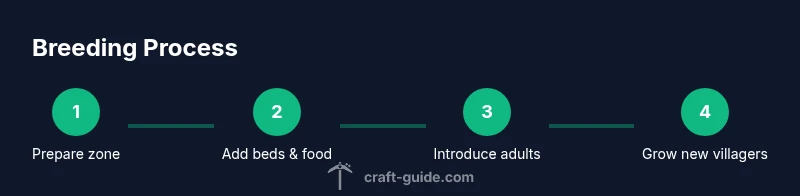
Design a dedicated breeding area that’s close to crops but protected from mobs. The setup should include: a double-digit bed count for adults, additional beds for babies, and a reliable food supply near the breeding zone. Place sufficient doors or ensure modern bed mechanics are satisfied, and keep the area well-lit. Create a wheat, carrot, or potato farm to feed villagers, and separate the breeding zone from storage and work areas to minimize wandering.
Once your zone is ready, introduce two adult villagers who have access to beds and food. If everything is aligned (food items nearby, beds available, and enclosure secured), breeding should occur. After babies appear, manage space and beds to accommodate growth while maintaining ongoing food production. Expect new villagers to join the population as days pass in-game; this steady growth is the foundation of a robust village.
Common Pitfalls and Troubleshooting
The most common issues that block breeding are insufficient beds, a lack of accessible food, or mobs invading the breeding area. Ensure beds exist for every adult and add extra beds for potential babies. Keep a farm near the village to provide a constant food source; without regular feeding, villagers may become unwilling and breeding will slow or stop. Lighting and secure fencing reduce mob interruptions, which can otherwise drive panic and reduce willingness.
If breeding stalls, check bed accessibility: villagers must be able to claim beds. If beds are blocked, even with food, breeding won’t proceed. Regularly assess population size and ensure there’s room for growth; a cramped village can quickly reach a ceiling that stops new births.
Advanced Tips for Efficient Villager Breeding
To maximize breeding efficiency, pair mature villagers with higher probability of willingness by keeping a consistent food supply and ensuring secure, spacious housing. Consider rotating two or three breeding couples in a controlled area to manage population growth. Use a compost or farmland system to keep crops growing and accessible, minimizing player intervention. Track population growth visually with signs or a map to ensure you hit long-term sustainability. Craft Guide’s guidance suggests placing farms at a comfortable distance from the breeding area to reduce congestion and keep villagers calm during growth.
Example Scenarios
Scenario A: A village with 8 beds and a nearby wheat farm experiences steady baby births as long as the two adults in the breeding zone stay willing. Scenario B: A village with 15 beds but no nearby food source runs into breeding stalls because villagers cannot stay fed. By aligning beds and crops, you keep births consistent. Scenario C: After babies mature, you must expand beds and housing gradually; neglecting growth causes bottlenecks and reduced breeding frequency.
Authority Sources
For further reading on the mechanics behind breeding in Minecraft and animal-like dynamics in simulations, consult credible sources such as Nature and Science journals. While Minecraft-specific details are covered by community wikis and guides, foundational breeding principles are supported by general research on resource management, animal reproduction, and game design.
Tools & Materials
- Beds(One bed per adult villager; include extra beds for babies)
- Food items (bread, carrots, potatoes, beetroots)(Stockpile and keep accessible near the breeding zone to keep villagers willing)
- Fencing materials(Walls and gates to create a secure breeding area)
- Farming setup(Nearby crops to supply a steady diet for villagers)
- Lighting (torches, lanterns)(Prevents hostile mob spawns and keeps the area calm)
Steps
Estimated time: 60-120 minutes
- 1
Choose and secure the breeding zone
Select a quiet, well-lit area near a farm. Build a secure enclosure with walls and gates to keep villagers inside and protected from mobs. This helps maintain a calm environment, supporting consistent breeding behavior.
Tip: Use transparent panes if you want to monitor villagers without obstructing access. - 2
Provide beds for adults and babies
Place a bed for every adult villager and add extra beds for potential babies. Beds are essential for triggering breeding; without beds, births won’t occur even if two villagers are willing.
Tip: Ensure beds are accessible and not blocked by doors or decorations. - 3
Stock the breeding area with food
Create or connect a nearby food source (wheat, carrots, potatoes, bread) so villagers can be fed easily. A steady food supply increases willingness and supports ongoing breeding.
Tip: Harvest crops regularly to keep stocks high and prevent scarcity. - 4
Introduce two breeding adults
Bring two mature villagers into the breeding zone with beds available. If they are willing and beds are free, breeding should begin and a baby villager will appear.
Tip: Assign workstations to villagers away from the breeding area to reduce distraction. - 5
Wait for a baby to appear and grow
A baby villager will appear after successful breeding and will take time to mature into an adult. Plan for growth in stages and prepare extra beds for eventual expansion.
Tip: Avoid moving babies too much; stability helps growth. - 6
Expand beds and infrastructure as needed
As babies mature, add more beds and additional housing to prevent crowding. Growth relies on space; lack of beds can halt further breeding.
Tip: Track population to anticipate when expansions will be necessary. - 7
Maintain a steady food supply
Continuously grow crops or maintain a farm near the village; villagers need food to stay willing for future breeding cycles.
Tip: Automate farming with redstone or villagers farming themselves where possible to reduce manual work. - 8
Protect from mobs and manage overcrowding
Keep the breeding area safe from zombies and other threats. Overcrowding reduces breeding efficiency; prune or restructure as populations grow.
Tip: Regularly inspect lighting and fence integrity to prevent breaches.
People Also Ask
How many beds are needed for villager breeding?
There must be enough beds for all adults plus additional beds for potential babies. Without beds, breeding cannot proceed even if villagers are willing.
You need beds for every adult villager and extra beds for babies to breed.
Is there a cooldown between breeding events?
There is no fixed cooldown timer. Breeding depends on willingness and available beds, along with a steady food supply.
Breeding isn’t timed; it happens when conditions are right, not on a set schedule.
What if there aren’t enough beds or food?
Without beds or adequate food, villagers won’t breed. Add beds and stockpile crops to resume breeding.
Lack of beds or food stops breeding; add beds and food to continue.
Can baby villagers themselves breed soon after birth?
Baby villagers cannot breed until they grow into adults. Once they reach breeding age, they can participate in future cycles.
Babies don’t breed; adults do after maturing.
Does depth of water or night vs day affect breeding?
Breeding is not strictly tied to day or night. What matters are beds, food, and adult villagers' willingness.
Time of day doesn’t control breeding; conditions do.
How can I prevent mobs from interrupting breeding?
Light up the area and use secure fences or walls to minimize mob spawns near the breeding zone.
Keep the breeding area well-lit and secure from mobs.
What’s the best layout for a breeding village?
Place beds in a spacious, connected area near a farm, with clear paths to water and crops to simplify feeding.
A spacious, well-fed layout near farming resources works best.
Can I breed villagers in multiplayer worlds?
Yes, but ensure shared beds and food resources; coordinate with other players to avoid overcrowding.
Breeding works in multiplayer if beds and food are managed in shared space.
Watch Video
The Essentials
- Ensure enough beds for adults and babies to allow breeding.
- Maintain a steady food supply to keep villagers willing.
- Breeding has no fixed cooldown; space and resources drive frequency.
- Grow infrastructure in step with population to sustain long-term breeding.
- Protect breeding zones from mobs and avoid overcrowding.