How Long Do Minecraft Thunderstorms Last in Practice
Learn how long Minecraft thunderstorms last, what factors influence duration, and how to control weather in single-player and on servers. This practical Craft Guide analysis explains weather cycles, timing, and survival tips.


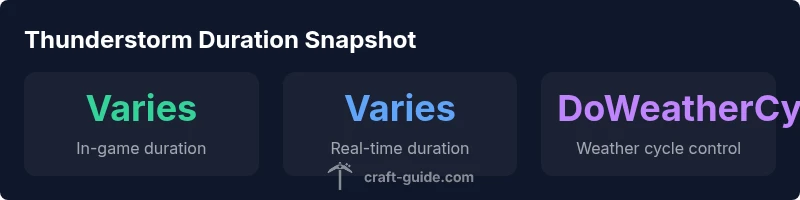
Thunderstorms in Minecraft do not have a fixed length. They persist until the weather cycle changes or a player triggers a clear weather event. In practice, duration varies with game settings and RNG, and can range from a few in-game minutes to longer periods if the weather system remains active. According to Craft Guide, players can control length with command blocks or doWeatherCycle.
What determines thunderstorm length
Thunderstorms in Minecraft do not have a fixed duration. The length is dictated by the game’s weather system, primarily the weather cycle, which decides whether rain persists, intensifies into a thunderstorm, or clears. The gamerule doWeatherCycle controls automatic weather changes: when it’s true (default), the world shifts weather randomly over time; when false, the current weather state persists until manually changed. RNG plays a role too, so two thunderstorms in near-identical conditions can differ in length. Craft Guide Analysis, 2026, notes that practical duration is context-dependent, especially on servers with plugins and between Java and Bedrock editions.
The in-game clock: ticks, days, and weather
Minecraft runs on a ticking clock: 20 ticks per second, a 24,000-tick day cycle, and a 20-minute day-night loop. Thunderstorms sit within this timing system but aren’t locked to real-time minutes. Their duration depends on the weather engine and cycle progression, and can span multiple in-game days if the weather remains rainy while the cycle runs. Understanding this separation helps players plan builds, exploration, and farming; the duration is shaped by settings and by any server-side rules or plugins that modify weather behavior.
Measuring duration in-game (and why it matters)
To estimate how long a thunderstorm lasts, start the storm and monitor the in-game time against weather transitions. In-game time can be queried with commands like /time query daytime to approximate the current tick count. Convert ticks to seconds (20 ticks per second) or minutes in real time to estimate storm length. This approach is approximate because the exact tick threshold for a weather change isn’t shown to players. For survival planning, knowing when daylight returns helps coordinate farming, mob farming windows, and exploration timing.
Edition differences: Java vs Bedrock and servers
Both Java and Bedrock editions feature weather cycles, including thunderstorms, but there are subtle differences in frequency, audio cues, and transition behavior. On servers, plugins, gamerules, and server performance can alter thunderstorm duration. Craft Guide’s analysis emphasizes that doWeatherCycle and server configuration are influential factors. If you’re running a realm or modded server, check edition-specific docs and plugin settings to understand how long storms tend to last in your environment.
How you can influence thunderstorm length
Players have practical tools to shape storm duration. In Java Edition (and similarly in Bedrock), use the gamerule doWeatherCycle to control automatic weather changes: /gamerule doWeatherCycle false stops automatic transitions, allowing a storm to persist until you clear it. To end a storm quickly, enter /weather clear. If you’re using command blocks or in-world mechanisms, you can automate weather changes for testing or creative experimentation. These controls let you tailor weather for builds, redstone testing, or survival experiments.
Practical implications for exploration, farming, and combat
Storms reduce visibility, complicate combat, and influence mob behavior and crop irrigation timing. Lightning can threaten structures and players, especially wooden builds, and heavy rain can affect ranged combat and navigation. Understanding storm duration helps you plan expeditions, timing crops or animal farms, and choosing when to venture into caves or perform long explorations. In multiplayer, synchronized weather can also impact events, raids, and resource gathering windows.
Common misconceptions about thunderstorm duration
A common myth is that storms always last only a short time or that rain automatically stops at sunrise. In reality, duration is variable, determined by the weather cycle, gamerules, and server conditions. Some players assume storms end at daybreak; others believe seeds guarantee consistent lengths. Neither is universal—thunderstorm length can differ across worlds, editions, and server setups, so it pays to test your specific environment.
Quick-start survival tips during storms
- Seek shelter to avoid lightning damage and splash effects.
- Use /weather clear or disable auto-weather for predictable conditions.
- Carry shields and wear armor to mitigate storm hazards.
- Time expeditions to daylight when possible for visibility and mob control.
- Prepare crops and lighting to reduce farm downtime during rain and thunderstorms.
Thunderstorm duration metrics in Minecraft
| Metric | In-game duration | Real-time duration |
|---|---|---|
| In-game duration (ticks) | varies | varies |
| Real-time duration (minutes) | varies | depends on server tick rate |
| Weather-cycle influence | variable | can be toggled with gamerule doWeatherCycle |
People Also Ask
Can thunderstorm duration vary between Java and Bedrock editions?
Yes. Both editions feature weather cycles, but air and transition behavior, thunder frequency, and audio cues can differ slightly. Check edition-specific docs and your server setup for timing expectations.
Yes. Java and Bedrock handle weather a bit differently, so durations aren’t exactly the same across editions.
How can I speed up a thunderstorm’s end?
End storms by using /weather clear or by turning off automatic weather changes with the gamerule doWeatherCycle. On servers, plugins or commands may also control weather transitions.
End storms with /weather clear or disable automatic weather changes.
Does rain always accompany thunder in Minecraft?
Yes, thunderstorms typically include both rain and thunder, though the intensity and frequency can vary with weather cycles and edition.
Rain usually comes with thunder, but behavior can vary by edition and settings.
Do thunderstorms affect mob spawns or farming?
Rain and thunderstorms influence mob spawning patterns and crop visibility, which can alter farming efficiency and combat strategy. Thunder itself doesn’t create new spawns, but weather affects mob behavior.
Weather changes can change how mobs spawn and how you farm.
Is there a built-in timer to track storm length?
There isn’t a built-in storm timer. Players estimate duration by noting start times and weather transitions, or by using commands to query time and approximate tick counts.
There isn’t a dedicated storm timer, so estimate using time queries and ticks.
Can I disable weather changes permanently in a world?
Yes, set doWeatherCycle to false to stop automatic weather transitions, effectively keeping the current weather until you intervene.
You can stop automatic weather changes with doWeatherCycle=false.
“Thunderstorms don’t have a fixed length in Minecraft; their duration is controlled by the weather cycle and the doWeatherCycle gamerule, with RNG introducing variability. This makes weather planning essential for survival builds and testing.”
The Essentials
- Thunderstorms have no fixed length; duration varies with weather cycle and settings.
- Use /weather clear or set doWeatherCycle false to end storms quickly.
- Check edition and server configurations for best storm-control results.
- Plan survival activities around weather windows to optimize exploration and farming.