How Big Is Minecraft Storage? A Practical Guide
Learn how big Minecraft storage really is—covering chests, ender chests, and shulker boxes—with practical layouts and scalable tips for 2026.


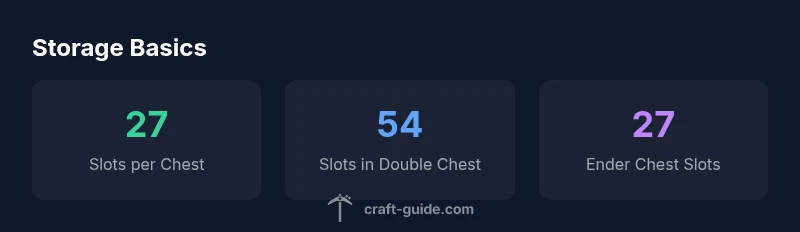
Minecraft storage scales with containers; a chest has 27 slots, a double chest 54, and shulker boxes also hold 27 slots. Ender chests offer 27 slots but are linked across dimensions, letting you access items worldwide. You can expand storage arbitrarily with many chests and sorters. For practical planning, most players size storage in multiples of 27 slots to keep sorting simple.
What storage means in Minecraft
Storage in Minecraft isn’t a single number. It’s a system built from containers that hold items, each with its own slot count. The phrase how big is minecraft storage refers to the total possible storage in a base, depending on how you combine chests, barrels, shulker boxes, and Ender chests. A chest in vanilla Minecraft has 27 slots, arranged in three rows of nine; you can join two chests side by side to form a double chest with 54 slots. Shulker boxes replicate that 27-slot capacity, but they are portable and save space when moving items. Ender chests share a unique mechanic: they’re 27-slot containers, but their contents are linked across the entire world, so you can access the same inventory from different locations. From a planning perspective, the size of your storage is not fixed; it grows with your base and your automation ambitions, especially in survival mode where looting and farming generate large item inventories.
Core container types and their capacities
Minecraft provides several core storage options, each with a standard capacity that you can combine to scale storage. The most common are chests (27 slots) and barrels (27 slots). Double chests, formed by placing two regular chests together, give you 54 slots. Shulker boxes carry 27 slots but are portable and stackable in inventories, making them ideal for moving large inventories. Ender chests have 27 slots, yet their items are accessible from anywhere in the world thanks to their linked storage mechanism. Trapped chests add no extra capacity; they operate the same as regular chests but emit a redstone signal when opened. When planning storage, the type and number of containers you deploy determine your total capacity.
Calculating total storage in a base
A practical way to estimate total capacity is to count your container types and multiply by their slot counts. For example, a line of 3 standard chests yields 81 slots (3 × 27). A row of 4 double chests would be 216 slots (4 × 54). Add shulker boxes for portability: each contributes 27 slots. Ender chests add a different dimension: you still have 27 slots per chest, but access is multi-location. When designing a base, always plan in multiples of 27 to keep sorting consistent and consider reserve space for sorting systems and drop-off zones.
Shulker boxes: portability and inventory
Shulker boxes are the standout portable storage solution. Each box retains 27 slots, just like a chest, but you can carry multiple boxes in your inventory and place them inside other containers. This makes them perfect for adventuring, moving resources between rooms, or building modular storage pods you can relocate as needed. Because they’re compact, they help keep your base clean while preserving large inventories. Remember that shulker boxes can be nested in chests or other boxes but retain their 27-slot capacity regardless of contents.
Ender chests: cross-dimension access
Ender chests provide a unique advantage: a 27-slot container whose contents are shared across dimensions. Items placed in an Ender chest on one world location are available in any other location where you access an Ender chest. This makes them invaluable for long-term storage strategies, trading runs, and emergency backups. Plan your world’s primary finance on storage hubs connected to an Ender chest network to simplify inventory management across bases, farms, and outposts.
Barrels and alternative storage options
Barrels offer 27-slot storage and are often used in compact builds or as a modern aesthetic alternative to wooden chests. They’re particularly useful when you want open, rotatable storage that fits into shelves or tight spaces. Other options include trapped chests (27 slots, with a redstone signal) and minecart chests (27 slots inside the cart, mobile storage). In base design, combine barrels for compact, accessible layouts with larger chests for bulk storage to create a balanced, scalable system.
Sorting and automation: how items fill slots
Automation and sorting systems help maximize storage efficiency. Simple item sorters route items into dedicated containers based on type, while hopper chains and comparator-based designs can automatically distribute loot from farms and mining runs. These setups reduce manual sorting and help keep your inventory tidy as you accumulate more loot. When planning automation, ensure you have clearly labeled sections and backups for overflow.
Practical layouts: storing common item groups
A practical approach is to organize by item family: blocks, resources, tools, food, and valuables. Use larger storage for bulk items (cobblestone, dirt, wood) and smaller, label-driven chests for rare items (diamonds, enchanted books). Attach a portable section with shulker boxes for quick expeditions. Always leave a central “drop zone” near your farming or mining areas to minimize walking time. This keeps your base efficient and ready for expansion.
Storage scaling: networks, item sorters, and automation
As you grow, storage networks become essential. Start with a central hub connected to branches for farms and mining zones. Implement item sorters with clear tiers (bulk, craftables, valuables) and plan for expansion by adding more containers and redstone paths. Regularly review your system to avoid bottlenecks and ensure overflow protection. A well-documented layout saves time and reduces chaos in large bases.
Performance and practical constraints: how big is Minecraft storage
Large storage networks can influence game performance, especially on servers or lower-end hardware. Avoid overloading a single chunk with thousands of items and consider distributing storage across multiple loading zones to minimize lag. Efficient designs include compact, modular pods rather than sprawling, monolithic warehouses. Balance aesthetics with practicality to sustain performance while maintaining ample capacity for play.
Common Minecraft storage containers and their capacities
| Container Type | Slots per Unit | Notes |
|---|---|---|
| Chest | 27 | Single unit; forms double chest when paired |
| Double Chest | 54 | Two chests side-by-side; maximum vanilla chest capacity in one block |
| Shulker Box | 27 | Portable storage; stackable in inventories |
| Ender Chest | 27 | Linked across dimensions; access from anywhere |
| Barrel | 27 | Alternative, compact storage option |
People Also Ask
How many slots does a standard chest have?
A standard chest has 27 slots. It can be paired with another chest to form a double chest, which doubles the capacity to 54 slots. This is the simplest expansion in vanilla storage.
A single chest has 27 slots, and a double chest has 54 slots; pairing chests is the easiest way to increase capacity.
What is a double chest and how many slots does it provide?
A double chest combines two standard chests side by side, giving 54 slots. It’s the most common first upgrade for base storage and helps reduce clutter.
A double chest gives 54 slots, combining two chests side by side for bigger storage.
Can shulker boxes be placed inside other containers?
Yes. You can place shulker boxes inside chests or other containers. Each shulker box still holds 27 slots, making them ideal for portable storage when you need to move lots of items.
Yes, you can put shulker boxes inside chests, and they keep 27 slots each for portable storage.
Are Ender chests shared across dimensions?
Ender chests have 27 slots, but their contents are accessible from any Ender chest across dimensions. This makes them excellent for global backup and quick access in multiple bases.
Ender chests offer 27 slots and can be accessed from anywhere in the world, across dimensions.
What’s the best way to layout storage for a small base?
Start with a central hub connected to farms and mining areas. Use labeled chests and consider shulker-box storage for portability. Plan for future expansion by leaving space for additional pods.
For small bases, center a hub, label chests, add portable storage, and leave room to expand later.
“Effective storage in Minecraft comes from modular design and scalable layouts, not a single mega chest. Build with future expansion in mind, and automation will do the heavy lifting.”
The Essentials
- Plan storage in multiples of 27 for easy sorting
- Double chests dramatically increase capacity
- Ender chests provide cross-d dimension access
- Shulker boxes enable portable, modular storage
- Design with scalability and automation in mind