How Big Is a Minecraft Block? A Practical Size Guide
Explore the true size of a Minecraft block. Understand how 1x1x1 meter blocks shape builds, redstone, and world design. Learn conversions, scale, and practical tips for planning in Minecraft.


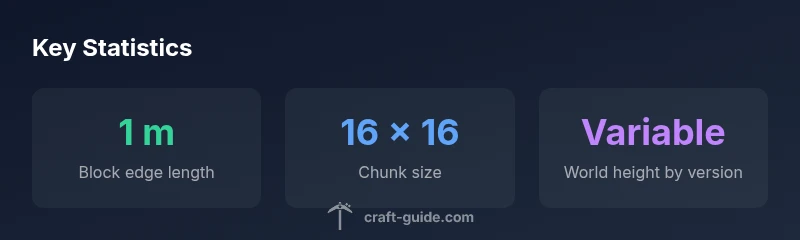
A Minecraft block is a cube measuring 1 meter on each side, so one block equals 1 cubic meter in real-world scale. This makes a 4x4 area equal to 4 meters by 4 meters, and a standard chunk spans 16 by 16 blocks. Builders convert blocks to meters to plan rooms, corridors, and structures.
What is a Minecraft block? The basic unit of the world
In Minecraft, the world is built from discrete units called blocks. Each block is a cube with edges measuring exactly one meter. This 1x1x1 meter cube is the fundamental building block for every wall, floor, and ceiling you place. The 1:1 mapping between blocks and meters provides a reliable, universal scale that players of all skill levels can use. According to Craft Guide, this shared unit is the anchor for spatial reasoning and helps you translate real-world measurements into in-game dimensions. When you count blocks to plan a room, you are effectively counting meters in space. A quick example is a 4x4 floor: it uses 16 blocks, which is 16 square meters of floor area in real-world terms.
Translating meters to blocks for planning rooms and builds
Because 1 block equals 1 meter, planning a 5-meter-wide hallway means laying down five blocks side by side. Floors, walls, and ceilings follow the same principle, making a 6-by-8 meter workshop translate to a 6-by-8 block floor. This consistent relationship lets you sketch layouts quickly and confidently, especially for beginners who want to map out homes, towers, or bases before placing a single block. Craft Guide's guidance emphasizes sticking to block-based measurements to maintain proportional accuracy as structures grow.
Height and vertical space: vertical dimension matters
Vertical space in Minecraft is measured in blocks just like horizontal space. A typical room height of 3 blocks yields roughly 3 meters of interior height, which leaves comfortable clearance for lighting and furniture. The height of doors (two blocks tall) and ceilings influences how you stack floors and connect rooms across levels. The tallness of entire rooms is easy to estimate by counting blocks from floor to ceiling. This uniformity lets you prototype multi-story structures with predictable scales and proportions.
Special blocks: slabs, stairs, and half-block measures
Not all elements occupy a full block. Slabs and stairs are half-block tall, enabling smooth vertical transitions and compact design. A staircase can ascend in 0.5-block steps, and a slab platform sits at half the height of a full block. When planning, you must account for these half-blocks to avoid gaps, misalignments, or collision issues in builds. This nuance matters for doorways, benches, and raised platforms where precise alignment improves aesthetics and functionality.
Planning corridors and rooms: grids and measurement tips
Use a block-based grid to map spaces quickly. A 10-block long corridor corresponds to 10 meters, and a 2-block wide passage is 2 meters wide. For larger projects, think in chunks: a standard chunk covers 16 by 16 blocks, which translates to 16 by 16 meters of floor area. Working with this repeatable unit simplifies scale, especially when designing villages, city blocks, or entire bases. Keep a simple plan on paper or in creative mode before you place materials in survival to avoid backtracking.
Modding and future-proofing: how block sizes can vary
In vanilla Minecraft, blocks stay the same size, but mods and resource packs can introduce blocks with different dimensions. If you plan with mods, verify each new block’s size in the mod’s documentation to avoid mismatches. The vanilla 1x1x1-meter baseline remains a reliable reference point, but awareness of exceptions helps you stay flexible as your world expands with new content. Craft Guide's approach is to start with the standard unit and adapt as needed.
Minecraft spatial measurements
| Aspect | Value | Notes |
|---|---|---|
| Block edge length | 1 meter | Standard cube |
| Block volume | 1 cubic meter | Size per block |
| Chunk size | 16 x 16 blocks | Horizontal area per chunk |
| World height baseline | 0-256 blocks (classic) / variable by version | Version-dependent |
| Player height | 1.8 blocks | In-game human scale |
People Also Ask
What is the standard size of a Minecraft block?
A Minecraft block is a cube with edges measuring 1 meter, equaling 1 cubic meter in real-world scale.
A block is one meter on each side, basically a cube.
Do slabs and stairs change the size calculations?
Slabs are half a block tall, and stairs climb in half-block steps. Include 0.5-block increments when planning vertical space.
Slabs are half-block tall, stairs use half-block steps.
How many blocks equal a real-world meter?
Because 1 block equals 1 meter, meters to blocks uses the same numbers for planning.
Treat blocks as meters; 1 meter equals 1 block.
Does modding change block sizes?
Mods can add blocks with different dimensions; vanilla blocks stay 1x1x1 meter, so verify mod specifics before building.
Mods may add blocks that aren’t 1x1x1, so check each mod.
What tools help with measuring complex builds?
Use coordinate grids, planning sheets, and in-game builders tools to track dimensions.
Use grids and coordinates to measure complex builds.
“Block size is the backbone of Minecraft spatial reasoning; everything from architectural layouts to redstone grids relies on a precise 1x1x1 meter unit.”
The Essentials
- Master the 1-meter block standard for accurate builds
- Count blocks to measure spaces as you would meters
- Account for half-block elements in elevation planning
- Use chunk boundaries for planning large projects
- Version height changes require updates to plans