Difference Between Minecraft and Minecraft Xbox One Edition: A Practical Comparison
Explore the key differences between Minecraft Java Edition and the Xbox One Edition, including platforms, features, updates, and cross‑play, to help you choose the right edition for your playstyle in 2026.


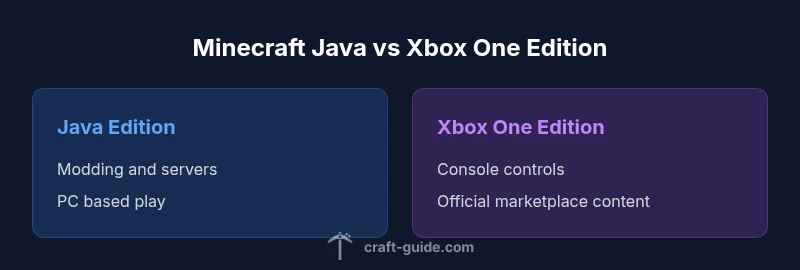
Overview: The difference between minecraft and minecraft xbox one edition centers on platform, updates, and ecosystem. Minecraft Java Edition (PC) emphasizes modding, custom servers, and cross platform play with other Bedrock devices via the new Bedrock edition. The Xbox One Edition, a console variant, used its own release cycle, controls, and marketplace. Today, Bedrock Edition unifies cross platform play, making the console edition legacy for most players.
Understanding the scope of the comparison
This article explains the difference between minecraft and minecraft xbox one edition and why it matters to players. The term minecraft in this context generally covers the mainline editions such as Java Edition on PC and Bedrock Edition across platforms, while minecraft xbox one edition refers to the console specific release historically used on Xbox consoles. By defining these boundaries, players can set expectations for features, updates, and ecosystem access. Craft Guide's analysis helps you map your hardware and playstyle to the right edition. The quick path is to think about where you play most and what content you want to access.
In practical terms, the comparison focuses on three axes: platform constraints, feature ecosystems, and update cadence. Understanding these axes helps readers anticipate differences in world generation, content delivery, and community resources. The Craft Guide team emphasizes that choosing the correct edition is not merely about nostalgia; it shapes permissions for mods, marketplace access, and multiplayer possibilities that affect long term enjoyment.
This section sets the stage for a deeper dive into how each edition behaves under real gameplay conditions and why players often feel pulled toward one path over another based on their devices and goals.
Edition history and platform boundaries
Minecraft Java Edition and the Xbox One Edition grew from different design goals and technical constraints. Java Edition exists as the long running PC variant with a strong emphasis on open modding, server customization, and an active modding community. Xbox One Edition originated as a console specific release with oversight from console ecosystems, featuring controls suited to gamepads, a curated content pipeline, and a separate update timeline. The historical separation created distinct ecosystems, with players often choosing based on their primary platform and preferred play style. As a result, many features and world behaviors diverged, reinforcing the idea that these are not identical experiences, even when both carry the Minecraft name.
From a practical standpoint, platform boundaries determine where you access content, how you participate in multiplayer, and which online stores you use. This matters for beginners who want to jump straight into playable worlds and for seasoned players who crave flexibility and customization. Craft Guide notes that while both editions once operated in parallel, today the cross‑platform story is dominated by Bedrock Edition, which bridges devices and opens a broader audience for creators.
Gameplay and world generation differences
The core gameplay loop—exploration, building, and survival—remains familiar across editions, but the underlying rules can feel different between Java Edition and Xbox One Edition. Java Edition has a long tradition of deep world customization, expansive crafting options, and a wider set of biomes, structures, and terrain features driven by community-tested seeds. Console editions historically used more constrained world generation rules, with subtle differences in cave systems, surface features, and seed behavior. These distinctions matter when players share seeds or collaborate on multiplayer worlds, because a seed that produces a sprawling jungle in Java might create a different landscape in the console edition. Understanding these differences helps players manage expectations when planning builds or sharing project goals with friends on another platform.
Another practical impact is content pacing: Java Edition communities often experiment with new mechanics through mods and datapacks, while console editions rely on official updates and licensed add-ons that fit the platform’s content policy. As a result, world design decisions and exploration routes can diverge, which is valuable context for players planning cross‑edition collaboration or those evaluating performance boundaries.
Controls and user experience
Input methods shape how you interact with Minecraft, and the contrast between Java Edition and Xbox One Edition reflects this. Java Edition is built around keyboard and mouse precision, which benefits complex redstone machines, large-scale builds, and modded content. The control scheme also aligns with PC performance tuning, configuration files, and in-depth world editing. In contrast, Xbox One Edition emphasizes console friendliness: a controller-centric interface, a streamlined inventory system, and a built‑in user experience that integrates tightly with Xbox Live and the console’s media ecosystem. This difference extends to world management: navigation, building workflows, and inventory handling feel distinct, which can influence which edition feels most comfortable to new and returning players.
For players upgrading from console to PC or vice versa, this switch can require adapting your building style and planning approach. The ergonomics of each platform drive different pacing and methods for creating large, detailed builds, and understanding these nuances helps players transition more smoothly between editions.
Content, marketplace, and monetization differences
Content delivery is one of the clearest contrasts between the two editions. Console editions often rely on official marketplaces for add-ons, skins, and texture packs, providing a curated selection of content with licensing and platform restrictions. Java Edition, famous for its open ecosystem, emphasizes community driven content through servers, datapacks, and mods. This difference affects how players customize their worlds and how creators monetize or share their work. The presence of a marketplace on console editions can simplify access to personalized content, while Java Edition's modding scene enables more experimental gameplay and bespoke experiences. For families and players who value simplicity, the marketplace approach can be attractive; for power users seeking extensive customization, Java Edition offers more control, albeit with a steeper learning curve.
This divergence also shapes the troubleshooting landscape and the kinds of user-generated resources you’ll encounter. A Java player might rely on community wikis, mod repositories, and server directories, while console players may consult official support channels and marketplace documentation. Craft Guide highlights that content strategy directly affects how players grow their worlds, how durable their builds are, and how easily they share them with friends.
Overall, the content and monetization ecosystems reflect the broader design philosophies of each edition: openness and customization on PC, and curated, platform-aligned experiences on consoles.
Updates, support, and cross platform play
Update cadence has historically differed between Java Edition and Xbox One Edition, again reflecting their distinct development tracks. Java Edition receives its own series of updates driven by the desktop community, with new features and experimental changes being tested across an active modding landscape. Console editions followed their own update cycles, often tied to platform certification processes and the console’s update pipeline. In recent years, Bedrock Edition has emerged as the unifying line that standardizes features across Windows, consoles, and mobile devices, enabling broader cross-platform play and a more consistent content strategy. This is a key reason many players migrate toward Bedrock when they want to play with friends across devices.
Understanding update dynamics helps players plan upgrades and decide whether their current edition meets their content needs. If you value rapid feature access and broad customization, Java Edition may be appealing. If cross‑device play and a streamlined content path are critical, Bedrock Edition is typically the better option for today’s Minecraft ecosystem.
Modding, add-ons, and community ecosystems
Modding is one of the defining differences between the two editions. Java Edition has long supported a vast array of mods, mod loaders, and server plugins that alter gameplay, visuals, or mechanics. This openness has cultivated a strong community around custom maps, minigames, and new survival experiences. Xbox One Edition, on the other hand, offered a more curated experience with official add-ons and a more controlled environment, which can limit creative freedom but provide a more streamlined, consistent user experience. The contrast matters for players who want to customize mechanics or design novel challenges. If your goal is heavy customization and experimentation, Java Edition remains unmatched. If you prefer a stable, plug-and-play experience with curated content, the console edition or Bedrock Edition provides a different appeal.
Community ecosystems, tutorials, and support forums follow these divides, with Java communities focusing on code-level tweaks and server operations, while console communities emphasize official channels and cross‑platform play within Bedrock. Craft Guide observes that both ecosystems offer distinct pathways to mastering Minecraft, and the choice often reflects a player’s comfort with technical tinkering versus streamlined, guided content.
Performance, hardware considerations, and optimization
Performance characteristics differ between editions due to hardware associations. Java Edition can demand more from a PC when modded worlds, large build projects, or high-resolution texture packs are involved. The fixed hardware of consoles yields stable, predictable performance and consistent experiences across devices, but with limitations on texture packs and certain advanced graphical options. Understanding these performance considerations is crucial when planning a project, especially for large builds, server hosting, or immersive exploration. Players should evaluate their hardware capabilities, desired world size, and the types of mods or add-ons they intend to use. In general, PC players looking for the most customization may opt for Java Edition, while console players seeking reliability and cross-device access may favor Bedrock Edition.
The bottom line is that performance expectations should drive edition choice. If you plan on extensive modding or large, highly customized worlds, a capable PC with Java Edition is typically ideal. If you want a consistent experience across devices and prefer official content pipelines, Bedrock Edition on Windows or a console remains a strong option.
Choosing the right edition: a practical decision guide
For players deciding between Minecraft Java Edition and Minecraft Xbox One Edition, the choice should hinge on platform and play goals. If you primarily game on PC and value open modding, server customization, and a broad creative toolkit, Java Edition is a compelling option. If you play with friends on consoles, value a curated content library, and want to participate in cross‑device play, Bedrock Edition is the pragmatic path to take today. While xbox one edition served its era, most players today migrate toward Bedrock to access cross‑platform play and ongoing updates. Craft Guide recommends aligning your choice with your main device, your appetite for customization, and whether cross‑device play is a priority for your group.
Comparison
| Feature | Minecraft Java Edition | Minecraft Xbox One Edition |
|---|---|---|
| Platform | PC (Windows/macOS/Linux) | Xbox One console |
| Cross-platform play | Cross‑play with Java players only on PC; no direct cross‑play with Xbox | Cross‑play limited to the Bedrock ecosystem across supported devices |
| Update cadence | Independent PC updates; modding can affect timing | Separate console update cycle; updates aligned with console ecosystem |
| Modding and customization | Rich modding support and server customization | Limited official add-ons; no external mod support |
| Content and marketplace | No official marketplace; content through servers and datapacks | Official console marketplace with skins, textures, and add-ons |
| World generation and seeds | Java generation rules; seeds may produce different results | Console generation rules; seeds may differ from Java |
| Performance expectations | Depends on PC hardware and mod usage | Fixed hardware with stable performance on console |
| Multiplayer options | Extensive server options and large modded communities | Online multiplayer via console network with built‑in options |
| Community ecosystem | Vibrant modding community; user-made maps and tools | Curated ecosystem with official content and support |
Benefits
- Clarifies platform-specific strengths and trade offs
- Helps players plan upgrades or purchases
- Aids families deciding on cross platform play
- Supports informed discussions with friends and communities
Negatives
- Can oversimplify nuanced differences between editions
- Some differences are historical and tied to legacy editions
- Bedrock consolidation may render legacy console Eds less relevant
- Requires readers to stay updated as edition statuses evolve
Bedrock Edition is the recommended path for most players seeking cross platform play and ongoing updates.
Bedrock unifies play across devices and remains the standard for cross platform play in 2026. Java Edition remains ideal for PC users who want deep modding and server customization, while console players or families benefit from the curated Bedrock ecosystem. The Craft Guide team emphasizes aligning your choice with your primary device and desired content access to maximize enjoyment.
People Also Ask
What is the main difference between Minecraft Java Edition and Xbox One Edition?
Java Edition runs on PC with robust modding and server options, while Xbox One Edition is a console variant with a separate update cycle and a built in marketplace. Cross‑play is limited to Bedrock Edition across devices.
Java is for PC modding and servers; Xbox One Edition is the console version with its own updates and marketplace. Cross‑play is mainly within Bedrock now.
Can I play Minecraft Java Edition with Xbox players?
Direct cross play between Java Edition and Xbox editions is not supported. Bedrock Edition across devices enables cross platform play.
No, Java and Xbox editions don’t cross play; Bedrock handles cross platform play.
Is the Xbox One Edition still updated?
Historically the Xbox One Edition had its own update path, but the modern Minecraft ecosystem centers on Bedrock Edition for ongoing updates and cross platform play.
The Xbox One Edition isn’t the main focus anymore; Bedrock covers updates now.
Which edition should a new player start with?
For most new players, Bedrock Edition is the recommended starting point because it supports cross platform play and a shared content ecosystem across devices.
If you’re starting fresh, Bedrock is usually the easiest way to play with friends on different devices.
How can I upgrade from Xbox One Edition to Bedrock?
You generally need to purchase Bedrock Edition separately to access cross platform features and unified updates. The legacy console edition cannot be upgraded directly within a single license.
You’d typically buy Bedrock to access cross‑platform features, as the old Xbox One Edition isn’t upgradable that way.
What are the main benefits of Java Edition?
Java Edition offers extensive modding support, a vibrant server ecosystem, and flexible customization that appeals to players who want deep control over gameplay and world design.
If you love mods and servers, Java Edition is where the action is.
The Essentials
- Choose Bedrock for cross‑platform play
- Java Edition excels in mods and custom servers
- Console ecosystems offer curated content via official marketplaces
- Legacy console editions are generally superseded by Bedrock
- Plan upgrades based on your primary device and content goals