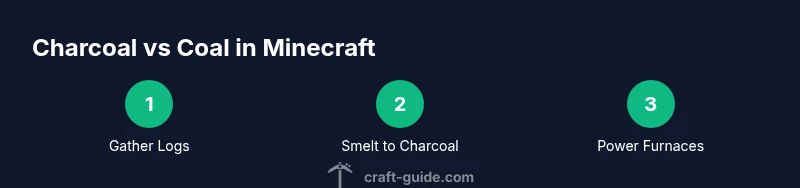
Charcoal vs Coal in Minecraft: A Practical Guide
Discover whether charcoal can replace coal in Minecraft, how to use it in furnaces and torches, and smart farming ideas to keep charcoal flowing in your base.


Yes. Charcoal can generally replace coal in Minecraft for furnaces, blast furnaces, torches, and most coal-based recipes. It burns for the same duration as coal, and it’s renewable, since you can produce charcoal by smelting logs. According to Craft Guide, this makes charcoal a practical, eco-friendly substitute for coal in most scenarios.
What charcoal is in Minecraft and how it differs from coal
Charcoal is a fuel item that you obtain by smelting logs in a furnace, while coal is mined from coal ore. For practical play, charcoal serves as a direct substitute for coal in most uses, including fueling furnaces and torches. The key takeaway is that charcoal is renewable: you can generate it repeatedly by smelting wood, which makes it a sustainable option, especially in early to mid-game. According to Craft Guide, this renewable aspect often makes charcoal the smarter long-term choice when tree coverage is high. Charcoal and coal also share many functional traits in crafting, smelting, and lighting, which means you won’t lose efficiency by switching between them in typical scenarios.
Can charcoal replace coal in furnaces and for smelting
In furnaces and blast furnaces, charcoal works as a fuel source just like coal. You can substitute charcoal for coal on a one-for-one basis in almost all fuel-related activities. This includes smelting ores, cooking food, and powering a furnace during resource gathering. The outcome of smelting remains the same regardless of whether you use charcoal or coal, so resource yields are unaffected. The only difference is the source: charcoal is renewable, coming from smelted wood, while coal must be mined. In practice, if you have abundant wood, charcoal keeps your operation running without needing to mine more coal.
Charcoal in crafting and torches: Same uses as coal
Beyond fueling furnaces, charcoal shares many other coal-based roles. Charcoal can be used in torches as a direct substitute for coal (the recipe requires a stick and a fuel; either coal or charcoal works). Some conversions and crafting recipes that historically required coal will accept charcoal instead, preserving your ability to craft lanterns, beacons-related items, and various fuel-dependent blocks. This parity helps players balance resource management: you can lean on charcoal for lighting and power without sacrificing access to needed items.
Renewable resource and farm ideas: How to get charcoal efficiently
Charcoal is renewable because it is produced by smelting wooden logs in a furnace. A practical approach is to gather logs from trees and set up a small charcoal production chain next to your base: supply a steady stream of logs, place them in a furnace, and collect charcoal as fuel. A simple wood harvest loop can keep your furnaces fueled for long stretches. If you want to scale, build a tree farm to ensure a continuous supply of logs. Craft Guide recommends optimizing your early-game wood-to-charcoal ratio so you aren’t bottlenecked by log collection during mid-game expansion.
Practical comparisons: Pros and cons of using charcoal vs coal
Pros of charcoal:
- Renewable and easy to replenish with wood.
- Great when you have plentiful trees or farms.
- Works identically to coal in furnaces and torches, enabling easy substitution.
Cons of charcoal:
- You must invest time to smelt logs first, which adds a step if you need immediate fuel.
- In very long mining expeditions, coal might be more efficient if you already have a coal reserve.
Craft Guide’s practical takeaway is that charcoal’s renewability often makes it the preferred option for players who prioritize sustainability and uninterrupted furnace operation, especially in villages or early-game bases where trees are abundant.
Tips for early-game and late-game transitions
In early-game, start substituting charcoal wherever coal would be used to fuel furnaces and torches. As you establish an oak or spruce wood farm, your charcoal supply grows without mining. In late-game, maintain a balanced approach: keep a coal stock for rare or longer-lasting fuel needs, but rely on charcoal for daily fuel and torch production when your wood supply is steady. Craft Guide emphasizes flexibility: switching between charcoal and coal as your resource landscape changes will keep your furnaces running smoothly across seasons and survival challenges.
Common pitfalls and troubleshooting
- Don’t assume torches must use coal; charcoal works as a substitute and helps you avoid mining coal blocks.
- When you see a furnace run out of fuel, check if you have a ready supply of charcoal produced from nearby wood; a quick switch can save time.
- If you’re setting up a charcoal farm, make sure you have a reliable wood source first; a small oak grove nearby makes production efficient.
Craft Guide perspective: best practices for using charcoal
The Craft Guide team prioritizes renewable fuel strategies that minimize resource strain. They recommend pairing a small charcoal-producing setup with your early mining operations. The idea is to keep your furnaces fueled while you focus on mining for ore, ensuring continuous progression. The Craft Guide approach emphasizes simplicity and sustainability: charcoal can be your go-to fuel during the first few Minecraft seasons, then transition to coal if a stable coal supply appears.
Tools & Materials
- Furnace(Primary fuel-powered block for smelting and cooking)
- Charcoal(Fuel substitute for coal; renewable from logs)
- Logs (any type)(Input to produce charcoal via smelting)
- Coal (optional for comparison)(Alternative fuel to compare behavior and efficiency)
- Torches (optional for testing)(Can be crafted with charcoal instead of coal)
Steps
Estimated time: 20-40 minutes
- 1
Gather logs and build a furnace
Collect a stack of logs and craft or place a furnace nearby. This step sets up your base for charcoal production and immediate fuel testing. Having a furnace ready allows you to swap coal for charcoal in real-world scenarios.
Tip: Suggestion: place your furnace near your wood farm for quick access to logs. - 2
Smelt logs to charcoal
Place logs in the top slot of the furnace and use any burnable fuel to smelt them into charcoal. This creates your renewable fuel source for future operations. The process is straightforward and mirrors coal production in reverse.
Tip: Tip: use an efficient fuel source to minimize overall resource use while producing charcoal. - 3
Substitute charcoal for coal in a furnace
Remove coal and place charcoal in the furnace in place of coal, then smelt a batch of items to confirm you get the same results. You’re testing one-for-one fuel replacement with no changes to output.
Tip: Pro tip: monitor fuel count to ensure you aren’t briefly out of fuel during smelting milestones. - 4
Test charcoal in torches and tools
Craft torches using charcoal in place of coal to verify every torch item is crafted correctly. This confirms that charcoal is a drop-in replacement for coal in common crafting recipes.
Tip: Pro tip: keep a small torch stock in your base for quick lighting before building in dark areas. - 5
Scale production for sustained use
If you rely on charcoal, expand your wood resources and create a dedicated charcoal production line. A steady flow of logs ensures you won’t run out of fuel during busy mining or building sessions.
Tip: Pro tip: automate log collection with a simple tree farm to keep charcoal flowing. - 6
Compare resource economics
Keep a small inventory of coal for reference, then compare the time and resources needed to produce charcoal versus gathering coal ore. This will help you decide when to lean on charcoal or coal.
Tip: Warning: over-optimizing for charcoal may temporarily slow down production if log gathering is limited. - 7
Document your setup
Take notes or screenshots of your furnace configurations and torches crafted with charcoal. This helps you replicate efficient setups in future worlds or share your approach with others.
Tip: Pro tip: maintain a simple checklist for charcoal vs coal scenarios. - 8
Review and adapt strategies
Periodically reassess whether charcoal should remain your primary fuel. If coal becomes abundant via mining, you can shift back and forth depending on your base’s resource distribution.
Tip: Pro tip: flexibility is key; adapt to your world’s resource landscape.
People Also Ask
Can you replace coal with charcoal in furnaces?
Yes. Charcoal can replace coal in furnaces and blast furnaces on a one-to-one basis, producing the same outputs and using the same burn time. This allows you to fuel your operations without mining coal.
Yes. Charcoal can replace coal in furnaces on a one-to-one basis, keeping your furnaces running without mining coal.
Do torches require coal or can charcoal be used?
Torches can be crafted with charcoal as a substitute for coal. This means you don’t need coal specifically to light your base; charcoal works just as well in the torch recipe.
Torches can be made with charcoal instead of coal, so you don’t need coal for lighting.
Is charcoal renewable and how do I obtain it?
Charcoal is renewable because it is produced by smelting logs in a furnace. You generate charcoal from wood, which makes it a sustainable fuel option when trees are available.
Charcoal is renewable because you can produce it by smelting logs from trees.
How can I obtain charcoal quickly in a new world?
Start by farming a small wood grove to supply logs, then set up a simple furnace chain to smelt those logs into charcoal. Keep a few furnaces running to convert wood efficiently and feed your fuel needs.
Grow a small wood farm, then smelt logs to charcoal to keep furnaces fueled efficiently.
Does charcoal work in blast furnaces or only regular furnaces?
Charcoal works as a fuel in blast furnaces just like coal, supporting faster ore processing and consistent fuel supply across furnace types.
Charcoal works in blast furnaces the same as coal, keeping ore processing steady.
Should I always use charcoal or keep coal on hand?
Use charcoal when you have a reliable wood source and want a renewable fuel. Keep coal on hand if you have abundant mining resources or need a long burn without producing more charcoal.
Use charcoal if you have wood, but keep coal handy if you’re mining a lot.
Watch Video
The Essentials
- Charcoal serves as a one-for-one coal substitute for most fuels.
- Charcoal is renewable, making it ideal for sustainable play.
- Use charcoal for torches and regular furnace operations to reduce coal needs.
- Set up a small tree farm to maintain a steady charcoal supply.
- Balance charcoal production with coal stockpiles for late-game efficiency.