What Level Are Diamonds on in Minecraft? A Practical Guide
Discover what level diamonds spawn on in Minecraft, how spawn ranges work, and the best mining strategies for Java and Bedrock editions. Learn practical tips to maximize your diamonds with clear, data-driven guidance.


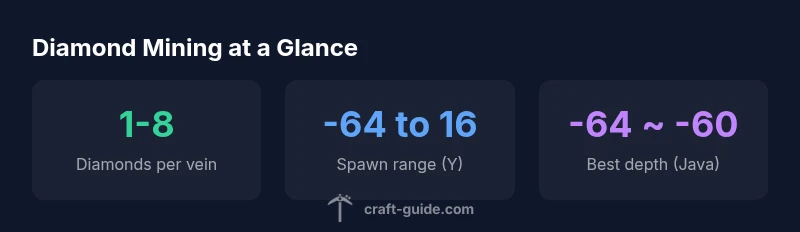
Diamonds spawn between Y levels -64 and 16 in modern Minecraft, with the deepest layers offering the most reliable yields. For practical mining, many players target the lower depths—around -64 to -60 in Java Edition—using efficient strip-mining or branch-mining patterns. This guide explains the level ranges, how distribution works, and how to optimize your mining runs.
what level is diamonds on in minecraft
According to Craft Guide, the short answer for modern Minecraft is that diamond ore spawns across a broad vertical range from Y -64 up to Y 16. This means you can encounter diamonds anywhere from the deepest depths to the upper caverns, but the density is not uniform. The Craft Guide team notes that the deepest layers tend to yield the most consistent results, especially when mining methodically. If you are aiming to maximize your diamond haul, you should plan your tunnels around the lower depth band while keeping an eye on lava pools and safe routes. For players new to mining, this can be a little daunting, but the payoff is worth the extra planning and care.
By understanding the spawn range and vein behavior, you can design a more efficient digging strategy that reduces guesswork and increases your chances of finding diamonds on each mining expedition.
Diamond distribution mechanics and what to expect
Diamond distribution is not perfectly even. Veins typically occur as discrete pockets rather than a continuous layer of ore. The ore density can vary by biome and edition, with Java Edition historically showing different vein spacing than Bedrock. Craft Guide analysis emphasizes that the practical takeaway is to expect multiple veins per mining run when you cover a wide area, but the exact count per chunk remains probabilistic. This means you should deploy mining patterns that expose multiple blocks per block dug, making branch-mining and wide tunnel layouts especially effective. Being systematic reduces wasted mining time and improves hit rates for diamond ore in the target depth range.
To maximize gains, miners often combine depth awareness with safety protocols, such as avoiding lava and carrying enough water or a fire resistance potion when needed. The general rule is to stay at depths where lava pools are present but avoid permanently unsafe zones; this balance allows you to reveal more ore without unnecessary risk.
Practical mining layouts for consistent diamond yields
A well-planned mining layout can dramatically increase your chances of locating diamonds without excessive digging. Two popular patterns are branch mining and strip mining. Branch mining uses a main corridor with evenly spaced branches that expose many blocks per unit of digging, while strip mining focuses on long, shallow-width tunnels that maximize exposure of blocks at the target depth. Craft Guide recommends starting at a depth around -64 to -60, then expanding corridors to create a grid that reveals ore on many sides. This approach minimizes wasted moves and makes it easier to follow a repeatable flow in each mining session. Don’t forget to place markers and keep track of your vertical progression to ensure you stay within the optimal range.
When implementing these layouts, consider lighting and safety: place torches regularly to prevent mob spawns and plan escape routes in case of lava or collapse. A good rule of thumb is to safeguard your main tunnel with a temporary water source or a shielded block path so you can retreat quickly if needed.
Java Edition vs Bedrock Edition: practical takeaways
Diamond spawn mechanics share the same fundamental range in both Java and Bedrock editions (-64 to 16), but there are edition-specific differences in vein density and distribution. Java Edition tends to show more predictable vein clustering in some versions, while Bedrock often has slightly more varied placement due to different world generation algorithms. For players switching between platforms, this means your mining cadence may adapt slightly: in Java, you might see more consistent yields with a disciplined branch-mining pattern, whereas Bedrock may reward broader tunneling with occasional higher-density pockets. Craft Guide’s cross-version analysis highlights the importance of testing a few tunnels in each edition to calibrate expectations and adjust your optimal depth accordingly.
A practical approach is to pick two depth bands within the -64 to -20 range for each edition and systematically explore them in separate sessions, comparing yields and adjusting your strategy as you go.
Tools, enchantments, and efficiency tips for mining diamonds
Having the right toolset can transform diamond mining from luck-based to knowledge-driven. An iron pickaxe or better is required to mine diamonds, but efficiency is enhanced by using enchantments such as Efficiency and Fortune. Fortune increases the number of diamonds dropped per vein, though Fortune does not affect the number of ore blocks found. Unbreaking extends the tool’s durability, which is particularly valuable for long mining runs. In Creative mode or with cheats, you can bypass these constraints, but for survival gameplay, combining Efficiency with Fortune (on a diamond pickaxe) can dramatically improve yield. Craft Guide’s practical guidance emphasizes balancing enchantment costs with your current resource goals and long-term playstyle.
To maximize results, pre-enchant your primary mining tool when possible, and consider combining Fortune with a temporary mining boost such as a beacon if you’ve reached a late-game phase. Always keep a spare pickaxe or two on hand so you aren’t stuck mid-run waiting for repairs.
Common mistakes that cost diamonds and how to avoid them
A frequent pitfall is mining at higher levels where diamonds are rarer, or not exploiting a proven mining pattern. Another mistake is ignoring safety: lava pools are common at the depths where diamonds are found, risking loss of time and resources. Running out of torches or food can derail a mining session quickly. Additionally, not tracking your location or failing to place markers can lead to wasted digging as you re-dig areas you already explored. Craft Guide recommends disciplined, repeatable mining patterns, consistent lighting, and safe exit routes to keep your expeditions productive and enjoyable.
Finally, avoid over-reliance on luck: while you can stumble onto diamonds at any depth, strategic planning and consistent technique are what drive sustained success.
Consolidating knowledge: applying what you learned to your world
Understanding the level distribution and practical mining patterns allows you to tailor your approach to your world’s goals. If you’re building a diamond-focused base, you might want to run regular mining expeditions at the lowest safe depth, accumulate diamonds across multiple trips, and then convert ore into tools and decorative blocks. Craft Guide’s integrated approach encourages you to combine depth strategy, tool enchantments, and efficient mining layouts to maximize results over time. By staying mindful of edition differences and maintaining a disciplined mining routine, you’ll find diamonds more predictably and with fewer risky detours.
Diamond ore distribution and mining patterns by edition
| Aspect | Diamond spawn range (Y) | Notes |
|---|---|---|
| Spawn range | -64 to 16 | Diamond ore can appear at any depth within this band; density varies by vein and edition |
| Vein size (diamonds/vein) | 1-8 | Common range; larger veins are less frequent |
| Best depth emphasis (Java) | Y -64 to -60 | Popular target range for reliable yields |
| Java vs Bedrock density | Similar broad range | Minor edition differences in vein spacing |
| Mining patterns | Branch/mining layouts | Expose multiple veins per session |
People Also Ask
What level do diamonds spawn in Minecraft?
Diamonds spawn between Y -64 and Y 16. For practical mining, focus on the lower depths, typically around -64 to -60, using efficient branch-mining patterns. Spawns vary by edition and world generation.
Diamonds appear from -64 to 16, with the deepest levels generally best for mining. Use a branch-mining pattern to increase exposure.
Java vs Bedrock: do diamond spawns differ?
Both editions share the same broad range for diamond spawns, but vein density and distribution can differ slightly. Practically, mine at the lower depths in both editions and adjust based on observed yields.
There are small differences in vein density between Java and Bedrock, but the overall depth range is the same.
What mining method yields the most diamonds?
Branch mining and strip mining at the lower depths are commonly recommended. These patterns maximize exposed blocks and improve the odds of finding multiple veins per session.
Use branch or strip mining at the lower depths to expose more blocks.
Can you find diamonds in caves or ravines?
Yes, caves and ravines provide opportunities to encounter diamonds, especially at deeper levels. However, systematic mining at lower depths is often more productive over time.
Yes, but plan deeper exploration and maintain a steady mining pattern for better results.
Do enchantments help diamond mining?
Efficiency speeds up mining, Fortune increases drops, and Unbreaking extends tool life. Combine these strategically to maximize returns on long mining sessions.
Enchantments like Efficiency and Fortune can boost speed and drops.
What are common mining mistakes to avoid?
Mining at the wrong depth, ignoring safety around lava, and lacking a repeatable pattern waste time. Use proven layouts, light consistently, and plan safe exits to improve efficiency.
Avoid depth mistakes and unsafe lava zones; use proven patterns.
“A disciplined mining plan, paired with the right tool enchantments, yields diamonds far more reliably than hoping for luck.”
The Essentials
- Target the lower depths for diamonds.
- Use branch or strip mining to maximize exposure.
- Fortune can increase diamond drops; efficiency helps overall pace.
- Java and Bedrock share the same general range, with edition differences.
- Plan, light, and stay safe to sustain long mining sessions.