Minecraft: How to Make a Trap Door
Learn how to craft wooden and iron trap doors in Minecraft, place them for hidden entrances, and integrate simple redstone. This educational tutorial covers materials, recipes, placement tips, and practical build ideas for both Java and Bedrock editions.


Learn how to craft wooden and iron trap doors in Minecraft, place them for hidden entrances, and use them in practical builds. This guide covers materials, crafting recipes, placement tips, and simple redstone ideas to create secure, hidden entries in your base.
What is a trap door in Minecraft?
In Minecraft, a trap door is a hinged block that can open and close to reveal space behind or beneath a surface. It behaves like a small doorway and can be placed on floors, walls, or ceilings depending on your build. For players curious about minecraft how to make trap door, trap doors provide a compact, modular option for hidden access points, secret rooms, and themed bases. They’re inexpensive to craft, easy to use, and compatible with both Java and Bedrock editions, making them a staple for practical builders and designers alike.
If you’re new to the game, trap doors come in two main varieties: wooden trap doors (made from wood planks) and iron trap doors (made from iron ingots). Wooden trap doors are more common in early-game builds due to their accessibility, while iron trap doors offer greater durability and a more industrial aesthetic. Understanding these differences will help you decide which type suits your project best.
Wooden vs iron trap doors: Pros and cons
Choosing between wooden and iron trap doors depends on your goals and world progression. Wooden trap doors are cheaper to craft and don’t require smelting or special resources, so they’re ideal for quick builds, interior decoration, and early-game bases. They’re also easier to dye or customize by using different wood types. Iron trap doors, on the other hand, are sturdier and have a distinct metallic look that suits modern or industrial builds. They also imply a higher resource cost, which can be a satisfying long-term project for players focusing on resource gathering.
From Craft Guide insights, wooden trap doors shine for aesthetic versatility and speed, while iron trap doors excel in durability and a more “techy” vibe. Regardless of type, trap doors can be used in sets to form double doors, hidden panels, or trap-triggered entrances that blend seamlessly into your design.
Tools & Materials
- Crafting table(Needed to access the 3x3 crafting grid and craft trap doors.)
- Wooden planks(At least 6 planks to craft 2 wooden trap doors; any wood type works.)
- Iron ingots(At least 6 ingots to craft 2 iron trap doors; more ingots for multiple doors.)
Steps
Estimated time: 20-40 minutes
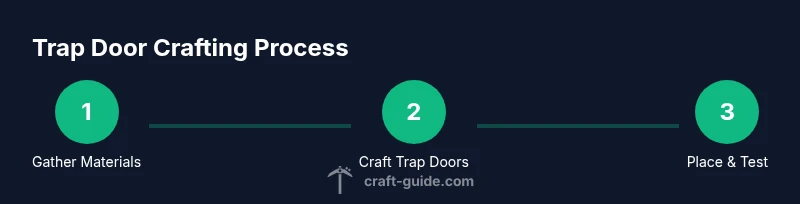
- 1
Gather materials
Collect wood planks or iron ingots and ensure you have a crafting table ready. Having all resources on hand prevents constant trips back to storage and speeds up the crafting process.
Tip: Organize your materials by type (wood vs iron) so you don’t mix recipes. - 2
Open crafting interface
Right-click the crafting table to open the 3x3 crafting grid. A grid that’s too small will slow you down, so make sure you’re in front of a table when you begin.
Tip: Tip: Place the crafting table in a wall niche to keep your workstation compact. - 3
Craft wooden trap doors
Place 6 wooden planks in a 3x2 rectangle to craft 2 wooden trap doors. This is the simplest production path for beginners.
Tip: Wooden trap doors don’t require smelting, so you can craft them immediately after gathering wood. - 4
Craft iron trap doors
Place 6 iron ingots in a 3x2 rectangle to craft 2 iron trap doors. This path yields stronger doors with a metallic look.
Tip: Iron trap doors are more resource-intensive; plan spaces where durability matters. - 5
Choose placement location
Decide where you want the door to be—floor, wall, or ceiling—based on your build’s flow and accessibility. Consistent placement helps you remember how to interact with it.
Tip: Know your camera angles in survival; flush placements look cleaner in screenshots. - 6
Place the trap door on a surface
Right-click or tap to place the trap door on the chosen surface. The door will hinge and can swing open when activated.
Tip: Ensure there’s no block directly above the hinge that could pop the trap door out of alignment. - 7
Test the opening direction
Open the trap door to confirm its orientation matches your intended flow. A door opened the wrong way can break your hidden-entry illusion.
Tip: If needed, rotate your body while placing to line the hinge with the wall or floor. - 8
Set up a hidden entrance
Pair two trap doors with a matching surface so the doorway remains concealed when closed. You can extend this with one or two more doors for a multi-panel look.
Tip: Use the surrounding blocks’ texture to blend the door into the environment. - 9
Add a simple activation method
For a basic opening mechanic, simply right-click to toggle the trap door. For hands-free control, use a pressure plate or button with redstone wiring.
Tip: Keep wiring compact and test the path to ensure the door doesn’t glitch. - 10
Test durability and cross-edition compatibility
If you’re playing on Bedrock vs Java, verify that the door behaves consistently in both editions. Tiny bugs can appear in one edition but not the other.
Tip: Cross-check with a friend’s world to ensureshared behavior. - 11
Expand to multi-door setups
When comfortable, create several trap doors in a row for a more dramatic hidden entry. This approach scales well for larger bases.
Tip: Align doors in perfect rows for a seamless, professional look. - 12
Clean up and finalize
Replace temporary blocks with final blocks, ensure signals are unobtrusive, and test the door in different lighting conditions to ensure consistent operation.
Tip: Take screenshots for your project log and future rebuilds.
People Also Ask
What is a trap door in Minecraft?
A trap door is a hinged surface that can be opened to reveal space behind or beneath a surface. It’s great for hidden entrances and compact access points in builds. It works in both Java and Bedrock editions and comes in wooden and iron varieties.
A trap door is a hinged block you can open or close to hide or reveal space in your build.
Can trap doors be used in both Java and Bedrock editions?
Yes. Trap doors function similarly in both editions, with minor interface differences. The crafting recipes and placement rules remain consistent across both versions.
Trap doors work in both Java and Bedrock editions, with small interface differences.
How many trap doors do you get per craft?
Crafting 6 wooden planks or 6 iron ingots yields 2 trap doors. This resource-efficient approach makes trap doors a practical choice for many builds.
Six planks or ingots make two trap doors.
Do I need redstone to open trap doors?
No. Trap doors can be opened by pressing the use key or tapping, but you can also wire them with redstone for automated or remote control.
Redstone isn’t required to open a trap door, but you can use it for automation.
Are there any safety concerns when using trap doors?
Trap doors are generally safe, but avoid placing them where falling through could cause injury or where mobs can surprise you at close range. When using iron trap doors, be mindful of the weight on pressure plates and switches.
Trap doors are safe, just plan their placement to avoid accidental drops or mob issues.
Watch Video
The Essentials
- Craft wooden trap doors for fast, affordable builds
- Choose iron for durable, secure entries
- Test orientation before final placement
- Integrate with redstone for automated access
- Experiment with multiple trap doors for dramatic effects