How to Make a Sign in Minecraft: Step-by-Step
Learn how to make a sign in Minecraft, place it, and customize text. This comprehensive guide covers crafting, placement, editing text, color codes, and practical uses for signs.


You will learn how to craft a sign in Minecraft, place it on a block, and edit its four-line text. You’ll use four wooden planks in a 2x2 grid to craft the sign, then right-click to enter text. This guide covers materials, placement, editing, color codes, and common uses for signs in builds and maps.
Understanding signs and their uses
In Minecraft, signs are simple, yet powerful for organization, lore, and navigation. They let you label chests, mark paths, give directions, or share notes with other players in your world. According to Craft Guide, signs shine in both solo play and collaborative builds because they are inexpensive to craft and quick to deploy. When you learn how to make a sign in Minecraft, you unlock a versatile tool for storytelling, base planning, and community projects. Signs work in most game modes and are a staple for early-game bases, as they require only a small handful of resources to create and implement. This understanding sets the stage for a smooth, step-by-step process.
Materials and setup
Before you craft a sign, gather four wooden planks of any wood type — oak, birch, spruce, jungle, acacia, or dark oak. You can craft the sign in your inventory’s 2x2 crafting grid or on a crafting table; both methods yield the same sign item. Crafting does not require any special tools. It’s a compact, beginner-friendly recipe, making signs an accessible addition to your Minecraft toolkit. The Craft Guide team notes that keeping wood types consistent gives your builds a cohesive aesthetic. Ensure you have a place to place the sign after crafting, such as a wall, fence post, or stair block, so it’s easy to read.
Crafting a sign
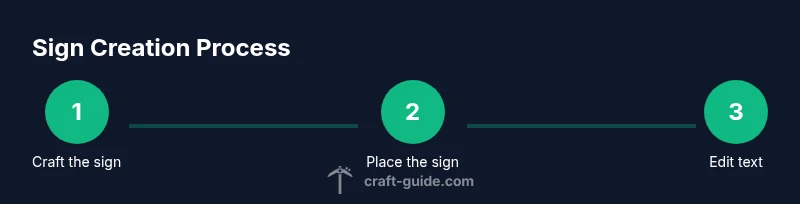
To craft a sign, open a 2x2 crafting grid and place four wooden planks in the grid. This arrangement produces one sign item. If you’re using a crafting table, the same 2x2 pattern applies. Once crafted, keep the sign in your inventory until you’re ready to place it. The sign’s appearance matches its wood type, but the text you write later is universal. This step is quick, and once you have the sign, you’re ready to choose a placement spot that maximizes readability for yourself and others.
Placing the sign
Find a suitable block where the sign will be readable. Right-click (PC) or use your platform’s interact button to place the sign on the chosen block. The orientation matters: stand facing the block you want to sign and place it so the text faces you or your audience. If you’re in a multi-player world, coordinate with teammates to avoid obstructing paths or entrances. Signs are small but impactful, so placement clarity is key for effective communication and navigation. Craft Guide emphasizes placing signs at eye level whenever possible for best readability.
Writing text on the sign
After placement, the sign’s text editor opens automatically. You’ll see four lines you can fill with your message. Type your first line, press the confirm action, then move to the next line until all four lines are used. Keep lines concise and legible; longer messages can become hard to read from a distance. If you make a mistake, you can remove the sign and craft a new one or replace the text during editing. Writing clear, short messages makes your signs instantly useful to players.
Color and formatting on signs
In Java Edition, you can color or stylize sign text using color codes inserted into the lines, such as the standard section sign colors. This is a more technical feature and may require copying color codes from a reference. Bedrock Edition handling of color has variations, so test your sign in your specific version to confirm how colors appear. Using color can help differentiate directions, warnings, or categories at a glance. Start with one color for headings or emphasis and expand only if readability remains strong.
Sign text length and line limits
Each sign supports four lines of text. Depending on translation and font rendering, each line has a practical character limit to ensure legibility. If your message is long, shorten phrasing or split information across multiple signs. For maps or bases, consider using abbreviations, symbols, or icons to convey meaning quickly. Consistent formatting across all signs helps readers understand your system or storyline faster.
Sign durability and removal
Signs don’t have a durability mechanic in the same sense as tools and armor, but they can be broken like any block. If you decide to move a sign, break it to drop a sign item and place it elsewhere. When you replace a sign, you can reuse the same block for a new message or relocate it to a new area. In multiplayer environments, communicate changes to teammates to prevent confusion and keep your signs up-to-date.
Practical uses for signs in builds
Signs are ideal for labeling chests, marking entrances, giving spawn directions, and narrating map lore. They’re small, quick to craft, and easy to update as your base grows. You can also use signs to leave signposts for visitors, note rules for your server, or categorize rooms in a modern build. Craft Guide’s approach emphasizes practicality: signs should improve navigation and storytelling without cluttering your space.
Signs with redstone and automation
Signs can interface with redstone by serving as informational displays for redstone-driven systems. For example, you can place a sign near a chest to label its contents, or use signs to show status like “On/Off” for a controller. While the logic of the mechanism remains separate, signs complement automation by providing human-readable cues. In community builds or adventure maps, signs help players understand how to interact with mechanisms and treasures.
Signs for maps and world-building
In large maps or sprawling bases, signs become essential for wayfinding and narrative. Use signs to label biomes, routes, dungeon entrances, or quest objectives. If you’re working on a story map, signs can present lore snippets between chapters, guiding players through your world’s geography. The simple act of placing a sign brings clarity to complex projects and helps players navigate your creative vision with ease.
Troubleshooting common issues
If text doesn’t save, ensure you’re using the correct interaction method for your platform and that you’re not in a restricted game mode. If the sign faces the wrong direction, pick it up and replace it with the intended orientation. For color codes, verify support in your edition and test on a small sign before applying widely. If signs become unreadable due to lighting or font scaling, adjust their placement height or contrast with surrounding blocks.
Quick-start sign ideas and challenges
Start with a simple sign near your chest labeling its contents. Create a map legend with signs along your base to guide visitors. For a small puzzle, use signs to present hints and directions that players must discover as they explore. As you gain confidence, expand to a sign system that labels rooms, banners, or a lore timeline. These ideas help you practice crafting, placement, and editing while adding personality to your world.
Tools & Materials
- wooden planks (4)(Any wood type; these four planks craft 1 sign in a 2x2 grid.)
- crafting interface (2x2 grid) or crafting table(Used to assemble the sign from four planks.)
Steps
Estimated time: Estimated total time: 10-15 minutes
- 1
Gather materials
Collect four wooden planks of your preferred wood type and prepare your crafting interface. You can use the 2x2 crafting grid in your inventory or a dedicated crafting table. Having a consistent wood type helps match other wooden elements in your build.
Tip: Choose a single wood type for a cohesive look across your signs. - 2
Open crafting interface
Open your 2x2 crafting grid and confirm you can place four planks in the grid. This step is quick and doesn’t require any special tools beyond your inventory access.
Tip: If using a crafting table, the grid remains the same, only the interface changes. - 3
Craft the sign
Arrange the four planks in a 2x2 square in the crafting grid to produce one sign item. Move the sign into your inventory for later placement.
Tip: Double-check the grid to ensure you’ve placed the planks correctly; a misplacement yields nothing. - 4
Choose placement
Find a block surface where the sign will be easily read by players. Consider eye level and open space so the message isn’t obstructed.
Tip: Avoid placing signs on blocks that will quickly be destroyed or moved. - 5
Place the sign
Right-click (PC) or use your platform’s interaction control to place the sign on the chosen block. Adjust orientation so the text faces your expected reader.
Tip: If you’re unsure about orientation, place one sign first and adjust after viewing from eye level. - 6
Enter sign text
The editor opens automatically. Type lines 1 through 4 with your message. Keep lines concise and legible for quick reading.
Tip: Break complex messages into shorter phrases; don’t overcrowd a single line. - 7
Confirm and review
Finish editing by confirming the text. Read the sign from different distances to ensure it’s readable and correctly conveys your intent.
Tip: Ask a friend to read it aloud; if they misread, shorten the lines. - 8
Optional color/formatting
If you’re on Java Edition and want color, add color codes to your lines. Test colors on a small sign first to ensure visibility.
Tip: Use color sparingly for emphasis; too many colors can be hard to read. - 9
Move or replace if needed
If the sign needs relocation, break it and craft a new one, then place it where it belongs. Keep your messaging consistent.
Tip: Document changes to avoid confusion for other players.
People Also Ask
Do I need a crafting table to make a sign?
No. You can craft a sign using a 2x2 crafting grid in your inventory or on a crafting table. The exact method is the same; the interface just changes. Crafting a sign is one of the simplest recipes in Minecraft, making it accessible to beginners.
You don’t need a crafting table to craft a sign; a 2x2 crafting grid works fine in your inventory.
How many lines can a sign have?
A sign has four lines for text. You can fill all lines or leave some blank. Plan your message so it fits within four lines and remains readable at a distance.
Signs support four lines of text. Use them wisely for short, clear messages.
Can I color sign text?
Yes, on Java Edition you can color text by inserting color codes into sign lines. Bedrock Edition may differ in how color works. Test on a single sign first to confirm how colors render in your version.
You can color text on signs in Java Edition with color codes; test to see how it looks in your version.
How do I remove a sign?
Simply break the sign block to remove it. It will drop as an item, which you can pick up and reuse elsewhere. This is useful if you need to relocate or update your messages.
Break the sign to remove it; you can reuse the sign item later.
Can signs be used in multiplayer worlds?
Yes. Signs work in multiplayer and can convey rules, directions, or lore to all players. Coordinate with others to place signs in accessible, logical spots so the world stays organized.
Signs work in multiplayer; use them to share directions or map lore with everyone.
What wood type should I use for signs?
Signs use wood planks, and their appearance matches the wood you use for crafting. Mixing wood types is possible but can look inconsistent. Choose a wood style that fits your build.
Sign texture follows the wood type you choose; pick a consistent wood for style.
Watch Video
The Essentials
- Craft a sign from four wooden planks.
- Place the sign on a readable surface at eye level.
- Edit four lines of text with a clear message.
- Color codes can enhance visibility on Java Edition.
- Use signs to organize, guide, and narrate your builds.