All Minecraft Potion Recipes: A Complete Brewing Guide
Explore all minecraft potion recipes with a detailed brewing guide, ingredient lists, and strategies for splash and lingering potions across Java and Bedrock editions.


All Minecraft potion recipes cover the full brewing system: from base Awkward Potions to a wide array of effects, including splash and lingering variants. This guide outlines the core recipes, essential ingredients, and practical tips for both Java and Bedrock editions, so you can brew powerful effects with confidence.
Why potion brewing matters
In Minecraft, potion brewing is a strategic pillar for exploration, combat, and resource management. For players aiming to optimize every build, knowing all minecraft potion recipes helps you plan loadouts, brewing times, and lab layout. According to Craft Guide, mastering the base system—Water Bottle, Nether Wart to craft Awkward Potions, then adding ingredients to produce effects—lays a foundation for every recipe you’ll use. Beyond simple health boosts, potions influence movement, visibility, resistance, and environmental control. This section introduces the core logic behind potions and shows how to create a reliable brewing workflow that scales from a single-player world to a server farm. Key terms like “base potion,” “efficacy,” and the difference between splash and lingering variants will be clarified. Whether you’re planning a compact lab or a sprawling potion farm, understanding these fundamentals makes every brew more predictable and powerful.
Core brewing basics
Brewing starts with a few core components: Water Bottles, Nether Wart, and the Brewing Stand. The essential flow is simple: fill bottles with water, craft Awkward Potions by combining Water Bottles with Nether Wart, then add a secondary ingredient to grant a specific effect. As you progress, you’ll learn to adjust potency with modifiers like Glowstone Dust (increase potency), Redstone Dust (extend duration), and Gunpowder (convert to Splash Potions). This section outlines a repeatable workflow and common lab setups, including how to organize ingredients for quick rotation during long brewing sessions. Remember to keep a clean inventory and label batches to avoid accidental misfires during hectic play.
The Awkward Potion and base recipes
The backbone of all potion crafting is the Awkward Potion, which is created by brewing Water Bottles with Nether Wart. From there, you swap in catalyst ingredients to create a wide range of effects. Slower or faster brewing times come with different enchanted components, and some effects require additional modifiers to reach the desired tier. For example, adding Glistering Melon to an Awkward Potion yields a Healing-based effect, while Sugar gives a speed boost. The general principle is consistency: once you master the base and a few reliable catalysts, you can reproduce most common potions with minimal variation.
Building a potion lab: equipment and layout
A practical lab design makes all the difference. A compact station with a Brewing Stand, a chest for ingredients, and labeled shelves speeds up workflows. A dedicated water source, a small water-bottle economy, and a plan for XP management (to refine results) reduce downtime between brews. This block covers shelf organization, storage solutions for rare reagents, and a suggested layout that minimizes walking distance while keeping critical items within reach. We also discuss starter budgets, the best trades or farming setups for quick ingredient access, and how to adapt the lab for survival, creative, or multiplayer servers.
Common potions: Healing, Speed, Night Vision, Fire Resistance, Strength, Invisibility
This section surveys widely-used potions and their general brewing patterns. Potion of Healing (Instant Health) starts from an Awkward Potion and Glistering Melon, while Potion of Swiftness uses Sugar as the catalyst. Night Vision typically employs a Golden Carrot, and Fire Resistance uses Magma Cream. Strength potions rely on Blaze Powder to boost melee damage, and Invisibility requires a complex ingredient approach. Each entry explains the base recipe, the expected effect, and practical deployment tips for combat, exploration, or farming.
Splash potions and Lingering variants
Splash Potions add tactical flexibility by throwing effects onto enemies or allies, while Lingering Potions create area-of-effect zones after impact. To convert a standard potion into a Splash Potion, add Gunpowder in the Brewing Stand. For Lingering Potions, you apply Dragon's Breath to a Splash Potion on Bedrock/Java variants depending on version. This section compares the two approaches, discusses when to use each, and explains how to optimize splash radius and duration for different scenarios—boss fights, team-based missions, or map-based challenges.
Ingredient cheat sheet and managing resources
High-demand ingredients include Nether Wart, Glistering Melon, Golden Carrots, Magma Cream, Sugar, Blaze Powder, and Gunpowder. This guide offers a practical cheat sheet: which ingredients unlock which effects, typical supply requirements, and recommended farming strategies. We discuss batching, inventory management, and how to rotate through effects to maintain a steady cadence of potions without running out of essential reagents in the middle of a build or raid.
Version differences and cross-platform notes
The core brewing mechanic is stable across Java and Bedrock editions, but you may encounter UI differences, ingredient substitutions, or minor recipe changes across updates. This section highlights the most common cross-version discrepancies and provides quick workarounds, especially for players who switch between platforms or join friends on different editions. It also notes how to verify your game version's brewing rules before committing to a long potion run.
Troubleshooting and optimization
If you run into failed brews, check your base ingredients, ensure you’re using the correct catalysts, and confirm you’re not mixing up potions with incompatible effects. This section provides a troubleshooting flow: verify base potions, test one-at-a-time catalysts, and document successful batches. We also cover common mistakes, like trying to apply an effect to an already strong potion without adjusting the base, and optimized lab workflows to minimize wasted time.
Advanced tips: redstone automation and potion farms
For builders and redstone enthusiasts, automation can dramatically increase efficiency. We cover concept-level strategies for brewing farms, bottle-filling systems, auto-sorting, and XP generation tied to potion production. The focus is on safe, scalable designs that work in survival mode, with notes on potential server restrictions and performance considerations. If you’re aiming for a self-sufficient lab that runs while you’re offline, these ideas can help you scale from a hobby project to a robust potion production line.
Common brewing recipes and their base ingredients
| Potion Type | Base Ingredient | Notes |
|---|---|---|
| Potion of Healing | Awkward Potion + Glistering Melon | Instant Health (I) |
| Potion of Swiftness | Awkward Potion + Sugar | Increases movement speed |
| Potion of Night Vision | Awkward Potion + Golden Carrot | See in the dark |
| Potion of Fire Resistance | Awkward Potion + Magma Cream | Fire protection |
People Also Ask
What is the first step to brewing any potion?
Begin with water bottles and Nether Wart to create Awkward Potions, then add a catalyst to obtain the desired effect. This base step is universal across most potions.
Start with water bottles and Nether Wart to make Awkward Potions, then add the effect catalyst.
How do I make a splash potion?
Brew the regular potion in a Brewing Stand, then add Gunpowder to convert it into a Splash Potion that can be thrown.
Brew the potion, then add Gunpowder to create a Splash Potion.
Which potions are best for exploration?
Night Vision and Swiftness are particularly useful for exploring caves and dark biomes; consider Fire Resistance for lava zones and Healing for survivability.
Night Vision and Swiftness are great for exploration, with Fire Resistance helpful in lava zones.
Do potions exist in both Java and Bedrock editions?
Yes, the core brewing system is similar on both editions, with minor differences in UI and some ingredient specifics.
Brewing is similar on Java and Bedrock, with small differences in interface and ingredients.
Can I brew potions without XP?
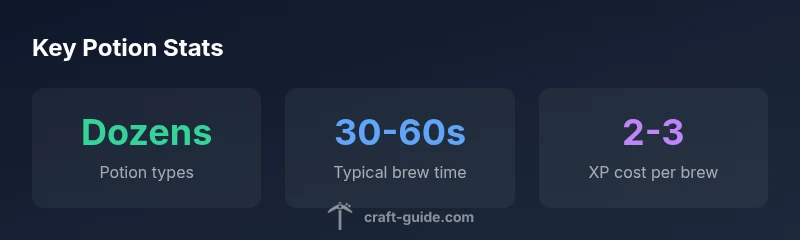
Brewing uses XP in the brewing stand interface, and XP costs can vary depending on the batch and upgrades you apply.
Brewing consumes XP in the brewing stand; costs vary with batch and modifiers.
What’s the difference between splash and lingering potions?
Splash Potions can be thrown to apply effects, while Lingering Potions create a larger-area effect after impact.
Splash potions are thrown; lingering potions create a bigger aura after they break.
“Brewing mastery comes from understanding how each ingredient shifts a potion’s potency and duration in real combat.”
The Essentials
- Master the base potion first.
- Align core potions with your playstyle.
- Use splash and lingering variants strategically.
- Batch-brew and label to boost efficiency.
- Adapt recipes across Java and Bedrock editions.