How to Minecraft Skins: A Practical Guide
Learn to design, customize, and apply Minecraft skins across Java and Bedrock editions. This step-by-step guide covers editors, PNG templates, uploading, and troubleshooting for creating unique in-game looks.


You will learn how to create and apply your own Minecraft skins, including choosing the right editor, saving a proper PNG, and uploading to your account. This guide covers pixel-perfect design, skin formats for different editions, and common pitfalls to avoid. By the end, you’ll craft a unique look and apply it in-game.
Why skins matter in Minecraft
Skins are more than cosmetic; they give players a visual identity, help you fit into communities, and communicate roles on servers. When you know how to minecraft skins, you can craft a consistent look that matches your play style—from stealthy explorers to bold heroes. In Java Edition, skins are stored on your Mojang account and downloaded by the client when you join a server; Bedrock Edition syncs across devices via Microsoft account. This means your skin travels with you, so invest in a design workflow you can reuse.
According to Craft Guide, the most memorable skins share a few traits: clear silhouette, readable color palette, and thoughtful shading that reads at a distance. Start with a simple concept, then iterate. A well-made skin should look good in different lighting and stay recognizable when viewed from the back or side. It should also avoid texture seams around limbs and the head. This article uses the phrase "how to minecraft skins" to anchor the topic and provide practical, stepwise guidance. The Craft Guide Team regularly emphasizes consistency and legibility as cornerstone principles for beginner and advanced designers alike.
Getting the right tools for skin design
Designing Minecraft skins effectively starts with the right toolkit. You don’t need studio-grade software; a capable image editor plus a reliable skin template is enough to begin. Popular online editors like Nova Skin and Skindex let you paint directly on a 64x64 pixel map, while traditional editors (GIMP, Photoshop, or Affinity) give you full control over layers and color management. For Java Edition, you’ll want a template that matches the 64x64 skin layout; Bedrock users should focus on the same PNG format, since the skin is applied to the player model in-game. Keep a copy of a clean template as your baseline and work non-destructively, saving incremental versions as you progress. Craft Guide’s guidance suggests starting with a simple cape-free, single-layer concept before adding shading and details to avoid texture seams.
Understanding textures and templates
Your skin is a 2D texture that maps onto a 3D model. The front, back, sides, head, arms, and legs all translate to different areas of the 64x64 PNG. When you design, keep each body part in its own region on the grid and test for edge alignment. Transparent areas must be handled with alpha channels correctly; accidental transparent gaps can create visual glitches in-game. Editors often provide live preview or fold-out UV maps to help you visualize how textures wrap around the torso and limbs. If you plan complex patterns or logos, sketch the rough layout first, then fill in with color, shading, and small highlights. The goal is a crisp signature look that remains readable when viewed from multiple angles and at various distances.
Design principles for a readable skin
A strong skin uses a cohesive palette with high contrast against the environment while maintaining legibility on small textures. Limit your color palette to 4–6 core colors to keep shading consistent across lighting. Use simple shapes to convey silhouettes; a clean outline helps you stand out on busy servers. Think about how your skin reads from the side and from behind—eyes, hair, and clothing patterns should not disappear into the texture. Consider symmetry vs. asymmetry: a mirrored design can look polished, but a small asymmetry (like a mark on one shoulder) adds personality. Before you finalize, zoom out to the smallest in-game size to ensure key features remain distinguishable at a distance.
Step-by-step workflow you can repeat
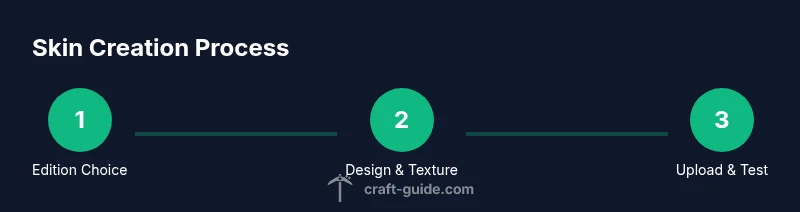
Starting with a fresh template, sketch your concept on paper or a digital draft. Translate the sketch into the skin map, then test by exporting a 64x64 PNG and uploading it to a viewer. If you notice seams, adjust seam lines in your editor and re-export. Compare multiple color variants to ensure readability across light levels. When you’re confident, save a high-quality PNG and prepare backup files for future edits. Craft Guide recommends maintaining a versioned library of skins so you can revert to earlier iterations if necessary.
Testing skins in-game and across editions
The best test is in-game play to evaluate lighting, shading, and legibility on your character as you perform actions. Java Edition skins upload via the official Mojang/Microsoft account login, where you apply the new texture to your profile and refresh the client. Bedrock Edition skins sync across devices through your Microsoft account, so test on at least two devices if possible. If a server uses resource packs or shaders, preview how your skin looks alongside those assets to avoid color clashes or misalignment. Craft Guide’s practical tip: keep a local backup of each skin you create so you can compare side-by-side versions.
Common mistakes and quick fixes
Texture seams around shoulders or limbs are common when the grid isn’t aligned with the 3D model. Use a crisp, limited color palette to avoid muddy shading, and test your skin in multiple lighting conditions. Saved PNGs should be lossless and uncompressed to preserve alpha transparency. If your skin looks stretched on some devices, recheck the skin map boundaries for the arms, legs, and head and adjust the template accordingly. Always validate that the head tiling and face texture line up with the model’s geometry. Recognition comes from clean lines and predictable shading, not heavy gradients on small pixel maps.
Advanced ideas: layered shading and thematic skins
Layered shading implies using light and dark tones to imply depth without overcomplicating the texture. Small highlights on the cheeks, hair, and clothing edges can create a sense of volume. A themed skin—like a knight, mage, or space explorer—benefits from consistent motifs across head, torso, and limbs. If you want a glossy look, emulate reflections with tight, light edge highlights on armor or visor panels. For players who run community servers, create a small set of signature palettes that fit your group’s theme while staying unique, so players recognize your team instantly.
The Craft Guide perspective and next steps
Craft Guide emphasizes a practical, repeatable workflow for how to minecraft skins. Start with a clear concept, test frequently, and maintain clean backups. Use templates to accelerate iterations and ensure your work remains accessible across Java and Bedrock editions. The Craft Guide Team recommends developing a personal style guide—document your preferred palettes, shading approach, and how you map textures to the model. With discipline and the right tools, you can craft skins that stand out without sacrificing performance or compatibility.
Tools & Materials
- Computer or tablet with internet access(For editing skins and uploading to Mojang/Microsoft account)
- Image editor (GIMP, Photoshop, or equivalent)(Use a pixel grid and export PNG without compression)
- Skin template (64x64 PNG)(Baseline layout for Java/Bedrock mapping)
- Access to skin editors (Nova Skin, Skindex, or similar)(Helpful for quick edits and previews)
- Mojang/Microsoft account credentials(Needed to upload and apply skins)
Steps
Estimated time: 1-2 hours
- 1
Choose edition and gather references
Decide whether you’re skinning for Java Edition or Bedrock Edition, then collect a few reference images of characters you like. This ensures your design fits the model and remains consistent across platforms.
Tip: Keep a quick-access folder of your sketches and color swatches. - 2
Select an editor and template
Open a skin editor or image editor and load a 64x64 template. Decide whether to start from scratch or adapt a simple base; test different palettes before committing to a color scheme.
Tip: Use a neutral background while designing to better judge color contrast. - 3
Sketch the concept on the map
Draft the head, torso, arms, and legs with clear lines for major features. Keep high-contrast areas on the silhouette so the design reads at distance.
Tip: Work with a separate layer for shading so you can toggle it on/off easily. - 4
Add color and shading
Apply a cohesive color palette, add shading in key areas, and ensure seams around joints are minimized. Preview frequently at small scales to simulate in-game appearance.
Tip: Limit the palette to 4–6 core colors for readability. - 5
Export as PNG (64x64)
Export the finished skin as an uncompressed PNG with 8-bit color depth. Confirm there is no stray transparency on skin regions that should be visible.
Tip: Always save a backup copy before any further edits. - 6
Upload to your account
Log in to the appropriate Minecraft account and upload the PNG to apply the skin to your character. Follow the on-screen prompts to confirm the change.
Tip: Preview the skin on multiple servers or devices if possible. - 7
Test in-game and iterate
Join a game and verify how the skin looks from all angles under different lighting. If something feels off, reopen the template, adjust seams, and re-export.
Tip: Maintain versioned skins so you can revert to a preferred look. - 8
Document and backup
Save your final PNGs alongside a notes file describing palette choices and naming conventions. Backups protect your work during updates or server changes.
Tip: Organize skins by theme for easy reuse on future projects.
People Also Ask
Can I use any image as a Minecraft skin?
No. Skins must be exported as a 64x64 PNG and mapped to the player model. Some images may not translate cleanly if they don’t align with the pixel grid.
You can’t use any image directly; it needs to fit the 64 by 64 pixel map and be saved as a PNG.
Do skins work across all platforms?
Skins work across Java and Bedrock, but the upload method differs. Java uses Mojang account profiles, while Bedrock syncs with your Microsoft account across devices.
Skins transfer across editions, but you’ll follow different upload steps depending on the platform.
How do I import a custom skin in Java Edition?
Log in to your Mojang account, navigate to profile or skin settings, and upload the PNG. The client may require a restart to apply the new texture.
Upload the PNG in your Mojang profile, then relaunch Minecraft to see the change.
Are there free editors I can use online?
Yes. Nova Skin and Skindex offer free, web-based skin editors with live previews. They’re great for beginners before moving to desktop tools.
There are free online editors you can start with to learn the basics.
What should I do if my skin looks stretched?
Revisit the skin map boundaries on the editor, and make sure each body part aligns with its pixel region. Re-export and test again.
Check the map alignment and re-export if it looks stretched.
Can I skin mobs or items like players?
Player skins apply to your avatar only. To alter mobs or items, you’d use resource packs or mods, which change textures globally rather than per-player skin files.
Skins affect players only; mobs need resource packs or mods.
Watch Video
The Essentials
- Design with a strong silhouette
- Test across lighting to ensure readability
- Use a small, cohesive color palette
- Backup versions before edits
- Upload and verify on Java and Bedrock